
Last updated: November 2026. Written by Syed Usman Riaz.
Link building is the work of getting other websites to link to your pages. Google still uses links to discover pages and to judge which ones are most useful (PageRank remains part of its core ranking systems), but it ignores or penalizes links made mainly to manipulate rankings. In 2026 the links worth having are earned: a relevant site chooses to link to you because you have something its readers need, such as original data, a useful tool, an expert answer or a real business relationship.
This guide covers how Google treats links, how to judge a good one, 12 white-hat strategies with outreach templates, how to measure results, what to avoid, and a 90-day plan for a small site.
Key takeaways
- Relevance beats volume. One link from a respected site in your field is worth more than dozens of links from unrelated directories.
- Earn links with something worth citing. Original data, free tools, expert answers and local relationships do most of the work.
- Paid links must be labeled. Buying links that pass ranking credit breaks Google’s spam policies; sponsored links need
rel="sponsored"orrel="nofollow". - Start with the free data. Search Console’s Links report and Bing Webmaster Tools show who already links to you.
- Links and mentions feed AI search too. AI answers draw on search indexes and on what other sites say about you.
What is link building?
Link building is any activity that leads another website to add a hyperlink to your site. That link is called a backlink (also inbound link or external link). The page that links out is the referring page, its site is the referring domain, and the clickable words are the anchor text.
Link building is part of off-page SEO, the search work that happens on other people’s websites. If you are new to the parts of SEO, start with what is SEO.
This guide is about earning links: creating reasons for sites to link and telling the right people. Placing links yourself through payments, swaps, networks or tools mostly breaks Google’s rules.
How does Google treat backlinks in 2026?
Google uses links in two ways. First, to discover pages: its crawler follows links from page to page. Second, to rank them: Google’s guide to its ranking systems says link analysis helps it understand what pages are about and which might be most helpful, and that PageRank “continues to be part of our core ranking systems”, even though it has changed a lot since 1998.
Google also fights links built to game that system. Its spam policies define link spam as creating links mainly to manipulate rankings. Examples include buying or selling links, excessive link exchanges, automated link programs, and links with optimized anchor text in articles, guest posts or press releases distributed on other sites.
Since its December 2022 link spam update, Google has said its AI-based spam system, SpamBrain, can detect sites that buy links and sites that exist to pass outgoing links, and that credit from unnatural links is nullified. In practice, most bad links today are simply ignored. Paying for them wastes money; at worst, a manual action removes rankings.
What do rel=”sponsored”, “ugc” and “nofollow” mean?
These are values of the rel attribute on a link. They tell Google about the relationship between the linking site and the linked page (Google: qualify your outbound links).
| Attribute | Use it for | Example |
|---|---|---|
rel="sponsored" | Ads, paid placements, sponsorships, affiliate links | A paid listing in an industry guide |
rel="ugc" | User-generated content | Links in blog comments or forum posts |
rel="nofollow" | Any other link you don’t want to vouch for | A link to a source you don’t trust |
| No attribute | Normal editorial links you stand behind | A blogger citing your study |
You can combine values, for example rel="ugc nofollow". Google treats these as signals rather than strict commands, and qualified links don’t pass ranking credit in the way an editorial link can. A paid link is fine under the spam policy if it is qualified this way. A nofollow link from a busy, relevant site is still worth having for the visitors and the visibility it brings.
What makes a good backlink?
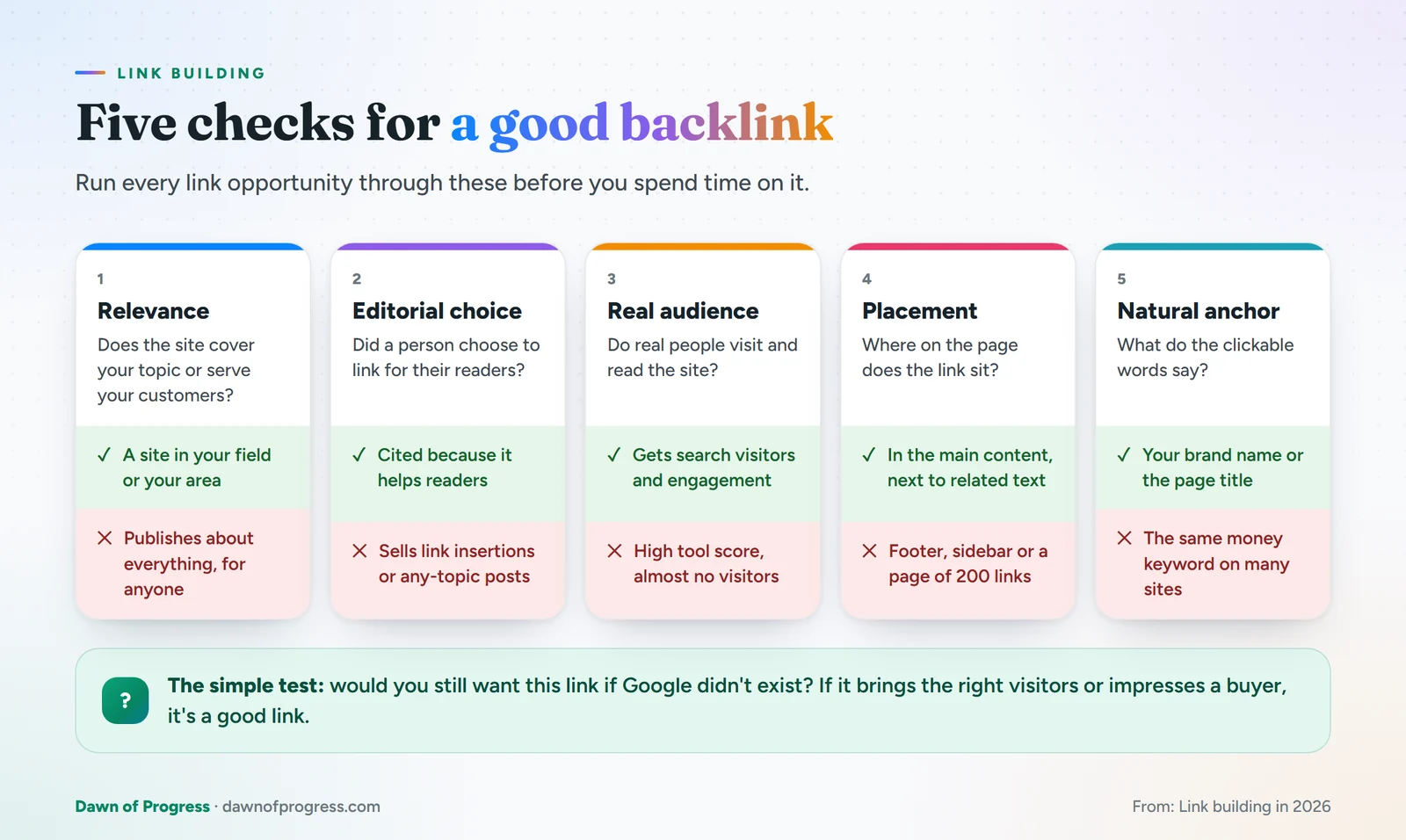
Judge every link opportunity on five things before you spend time on it:
| Factor | Good sign | Warning sign |
|---|---|---|
| Relevance | The site covers your topic or serves your customers | A site that publishes about everything, from casinos to dentistry |
| Editorial choice | A person chose to link because the content helps their readers | The site sells “link insertions” or has a “write for us, any topic” page |
| Real audience | The site gets organic search visitors and people engage with it | High “authority score” but almost no traffic or engagement |
| Placement | Inside the main content, near related text, with descriptive anchor text | Footer, sidebar, author bio or a page of 200 outgoing links |
| Natural anchor text | Your brand name, page title or a plain description | Exact-match money keywords repeated across many sites |
Third-party scores such as Domain Authority, Domain Rating or Authority Score are estimates made by tool companies. Google doesn’t use them. They are useful for sorting a list, not for deciding whether a link is good.
A simple test I use with clients: would I want this link if Google didn’t exist? If it would send the right visitors or impress a buyer who saw it, it’s a good link. If its only purpose is rankings, skip it.
How do you build backlinks? 12 white-hat strategies
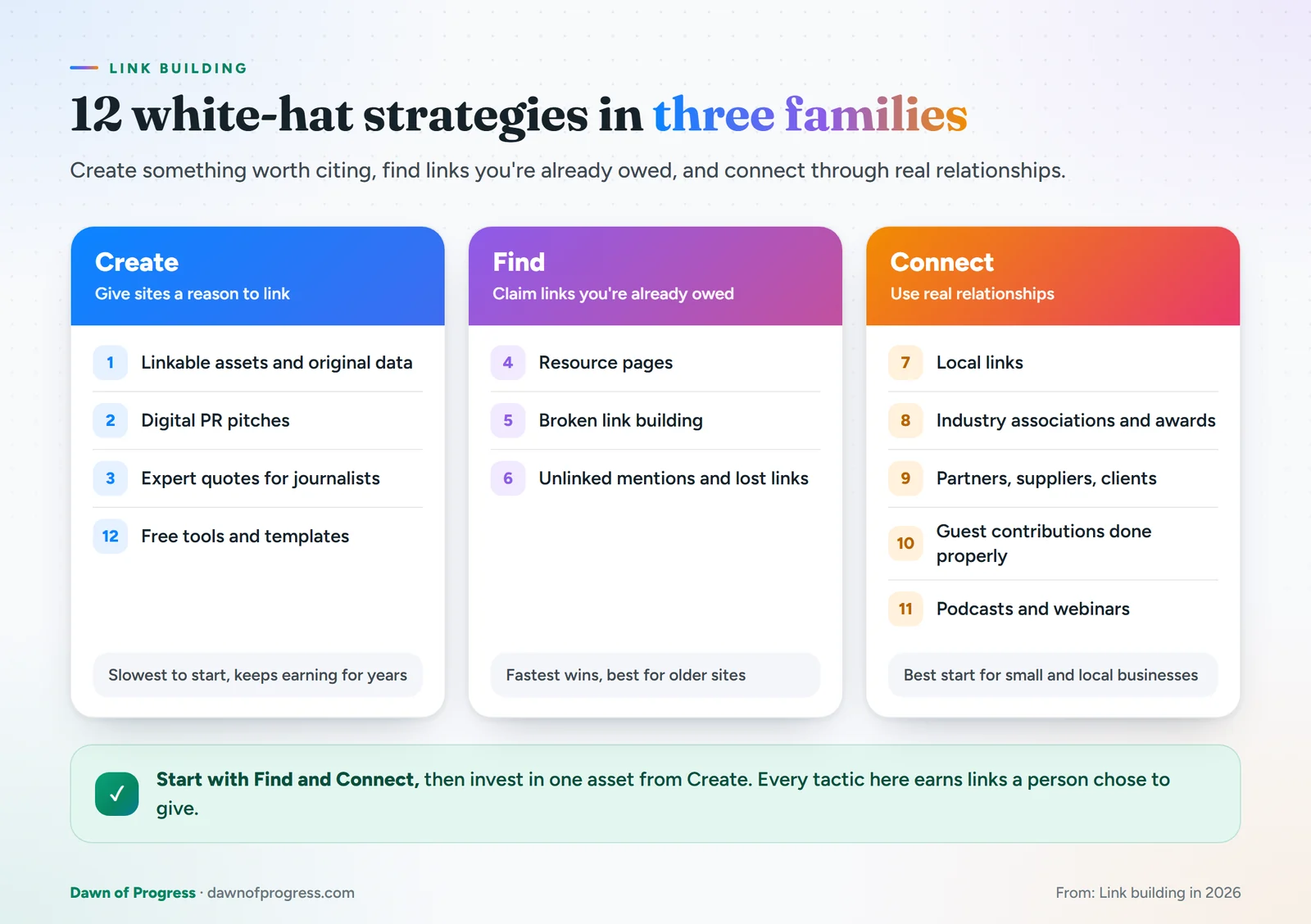
The strategies fall into three families: create something worth linking to, find links you are already owed, and connect through real relationships. Most small sites should start with the “find” and “connect” groups because they are faster, then invest in “create”.
1. Publish linkable assets and original data
A linkable asset is a page people cite because it saves them work. The strongest asset is original data: a survey of your customers, prices you collected across 50 suppliers, results from tests you ran, or a yearly report on your niche. Journalists and bloggers need numbers they can quote, and they link to the source.
How to do it:
- List questions in your field that people ask but nobody has answered with data.
- Collect the data honestly (your own records, a survey, public datasets you analyze).
- Publish a page with the headline findings at the top, a clear method section and charts others can embed with credit.
- Tell the people who write about that topic (see digital PR below).
2. Run digital PR
Digital PR means pitching a newsworthy story to journalists and editors so they cover it online and link to you. The story can be your data, a strong expert opinion on current news, or a local first.
The pitch must be about their readers, not your business. Find writers who covered a similar topic in the last few months, and send each one a short, personal email. Expect most pitches to get no reply. That is normal.
3. Give expert quotes to journalists
Journalists ask for expert sources every day. Answer quickly, answer well, and some will quote you with a link.
Platforms to try in 2026:
- HARO (Help a Reporter Out): Cision shut the original service down, then sold it to Featured.com in April 2025, which relaunched it with free daily query emails.
- Featured.com: expert Q&A that publishers use for quotes.
- Qwoted: a journalist request platform with a free tier and paid plans.
- Source of Sources (SOS): a free email service started in 2024 by HARO’s original founder, Peter Shankman.
Check each platform’s current terms before you join; these services change hands and rules often. And answer only where you have real expertise. A short, specific answer with one example beats a generic paragraph, and editors spot AI-written replies.
4. Get listed on resource pages
Resource pages are curated lists of useful links, such as “Resources for first-time home buyers” on a council or charity site. Search for them with operators like these:
"useful resources" + your topic
intitle:resources + your topic
inurl:links + your city
Only pitch pages where your page truly fits and adds something the list lacks. A free guide or tool has a far better chance than a sales page.
5. Do broken link building
Broken link building means finding a dead link on someone else’s page and suggesting your page as a replacement. You help the site owner fix a problem, so they have a reason to reply.
How to do it:
- Find pages in your niche with many outgoing links (resource pages, guides).
- Check them for broken links with a browser extension or a crawler such as Screaming Frog.
- Look up the dead page in the Wayback Machine to see what it covered.
- If you have (or can create) a better page on that topic, email the owner with the exact location of the broken link.
6. Reclaim unlinked mentions and lost links
An unlinked mention is when a site names your business or product without linking. Search your brand name in quotes, excluding your own site:
"Your Brand Name" -site:yourdomain.comWhen the mention is positive and recent, ask politely for a link to the page that helps their readers most. Also check for lost links: links to pages you deleted or moved. Redirect those old URLs to the closest live page with a 301 redirect. This is often the fastest win on an older site, and my SEO audit guide shows how to find them.
7. Earn local links
For local businesses, links from your own area carry strong relevance. Good sources:
- Your chamber of commerce or business association membership page
- Local news sites, covering a genuine story (an opening, an anniversary, a charity drive)
- Schools, clubs and events you support (sponsor links are paid, so expect them to carry
rel="sponsored"; the value is local visibility and visitors) - Local bloggers and “best of” guides for your city
Pair this with a complete Google Business Profile.
8. Earn industry links
Every field has trade associations, certification bodies, awards, conference sites and respected directories. Membership and listings on these sites are relevant links that competitors often ignore. Choose directories that people in your industry actually use and that check their listings. Skip any directory that accepts every submission for a fee.
9. Ask partners, suppliers and customers
Businesses you already work with are the easiest links to get:
- Suppliers and manufacturers often list stockists, resellers or certified installers.
- Software and tools you use often publish customer stories or partner directories.
- Clients may feature a case study or a testimonial that names you.
Keep it natural. A few genuine partner links are normal. A “partners” page built to swap links with dozens of unrelated sites is the “excessive link exchange” Google’s spam policy describes.
10. Write guest contributions, done properly
Guest posting still works when the goal is to reach a real audience. It fails when the goal is the link.
Done properly means:
- Pitch sites your customers actually read, with a topic idea first, not a finished article.
- Write something as good as your best on-site content, with your own experience in it.
- Link to your site only where it helps the reader, usually once, with your brand name or a plain description as anchor text.
- Accept the site’s link rules, including nofollow.
Avoid sites that publish anything for a fee, and never run large guest post campaigns with keyword-stuffed anchors. Google’s spam policy names exactly that.
11. Appear on podcasts and webinars
Podcast hosts need guests every week, and episode pages usually include show notes with links to the guest’s site. Pitch shows your buyers listen to, with three specific topics you can talk about.
12. Build free tools and templates
Calculators, checklists, templates, cost estimators and simple generators keep earning links for years because people link to tools they use. Examples: a VAT calculator for an accounting firm, a moving checklist for a removals company, a paint quantity calculator for a decorator. Keep the tool fast, mobile-friendly and free to use without signing up, and explain how it works on the page.
What outreach email templates work?
Short, specific and personal emails get replies. Use these as starting points, then rewrite them in your own words for each person. If you draft with AI, check every fact and remove anything generic; editors notice generic AI wording fast.
Template: broken link
“Hi [first name], I was reading your page [page title] and noticed the link to [dead page title] in the [section name] section now goes to an error page. I wrote a guide on the same topic that’s up to date for 2026: [URL]. It might work as a replacement, but any working source would fix it for your readers. Thanks for keeping such a useful list. [Your name]”
Template: unlinked mention
“Hi [first name], thank you for mentioning [your business] in [article title]. Would you consider linking our name to [URL], so readers can find [the specific thing mentioned] easily? Either way, I appreciate the mention. [Your name]”
Template: data story pitch to a journalist
“Hi [first name], I saw your piece on [related article]. We just published [one-line finding, for example: ‘what 300 small businesses in X paid for Y in 2026’]. Three findings your readers may find useful: [finding 1], [finding 2], [finding 3]. The full data and method are here: [URL]. Happy to send the raw spreadsheet or answer questions. [Your name, role, phone]”
Template: guest contribution pitch
“Hi [first name], I’ve read [site] for a while, especially [specific article]. I’d like to write a practical piece for your readers on one of these: [topic 1], [topic 2], [topic 3]. Each would draw on my experience of [your real experience]. Here are two pieces I’ve written: [links]. Would one of these fit your plans? [Your name]”
Rules that matter more than the template: one email per person, one polite follow-up after about a week, and no bulk sends. If someone says no, thank them and stop.
How do you measure link building?
Measure what links do for the business, not only how many you have.
- Search Console, Links report. Under External links you’ll find Top linked pages, Top linking sites and Top linking text. Google says the report is a sample, not a complete list, tables show up to 1,000 rows, and it doesn’t show whether a link is nofollow (Search Console Help: Links report). Export “Latest links” from the main page to see newly found links. My Google Search Console guide walks through the setup.
- Bing Webmaster Tools, Backlinks. A second, independent list of linking sites, with a competitor comparison.
- Referring domains, not total links. Count unique sites. 200 links from one site’s sidebar are worth less than one link each from five relevant sites.
- Referral traffic in GA4. Real visitors arriving from the links you earned.
- Rankings and clicks for the target pages. Compare Search Console clicks and average position for linked pages before and after, over 2 to 3 months, not days.
- Enquiries and sales. The number that pays for the work.
What link building tactics should you avoid?
| Tactic | Why to avoid it | Do this instead |
|---|---|---|
| Buying links that pass ranking credit | Named in Google’s link spam policy; SpamBrain targets link sellers | Pay for ads or sponsorships with rel="sponsored" |
| Private blog networks (PBNs) | Sites built only to link out, often on expired domains; Google treats repurposing expired domains to manipulate rankings as spam | Build one strong site |
| Link exchanges at scale | “Link to me and I’ll link to you” in excess is link spam | Link to partners only when it helps readers |
| Automated link tools and comment spam | Named in the spam policy; links are ignored | Join communities as a real person |
| AI-written guest posts and “parasite” articles | Scaled low-value content and site reputation abuse are both spam policies | Write fewer, better pieces with real experience |
| Exact-match anchors everywhere | Unnatural pattern; named in the policy for distributed articles | Let others choose anchors; usually your brand |
| Low-quality directories and widget links | Named in the spam policy | Join the few directories your buyers use |
And don’t panic about “toxic links” in third-party tools. Google ignores most spammy links on its own. Use the disavow tool only if you have a manual action for unnatural links, or you know someone built paid links for your site.
How do links relate to AI search citations?
AI search tools build their answers from search indexes. Google’s AI Overviews and AI Mode use Google’s index, Copilot uses Bing’s, and ChatGPT search uses its own crawler plus third-party search providers. Since links still help pages get found and ranked, they also help pages become candidates for AI answers.
Links help AI visibility in two more ways:
- Discovery. A new page with links from other sites gets crawled sooner.
- Mentions. AI answers often reflect what many sites say about a business: who recommends it, which lists include it, how reviews describe it. A mention without a link can still shape how an AI describes you.
So the same work counts twice. Digital PR, expert quotes, industry lists and podcasts earn links for Google and mentions for AI answers. I explain the overlap in SEO vs GEO and the AI side in LLM SEO. No public study proves a fixed link-to-citation ratio, so be wary of anyone who promises AI citations from a link package.
What does a 90-day link building plan look like for a small site?
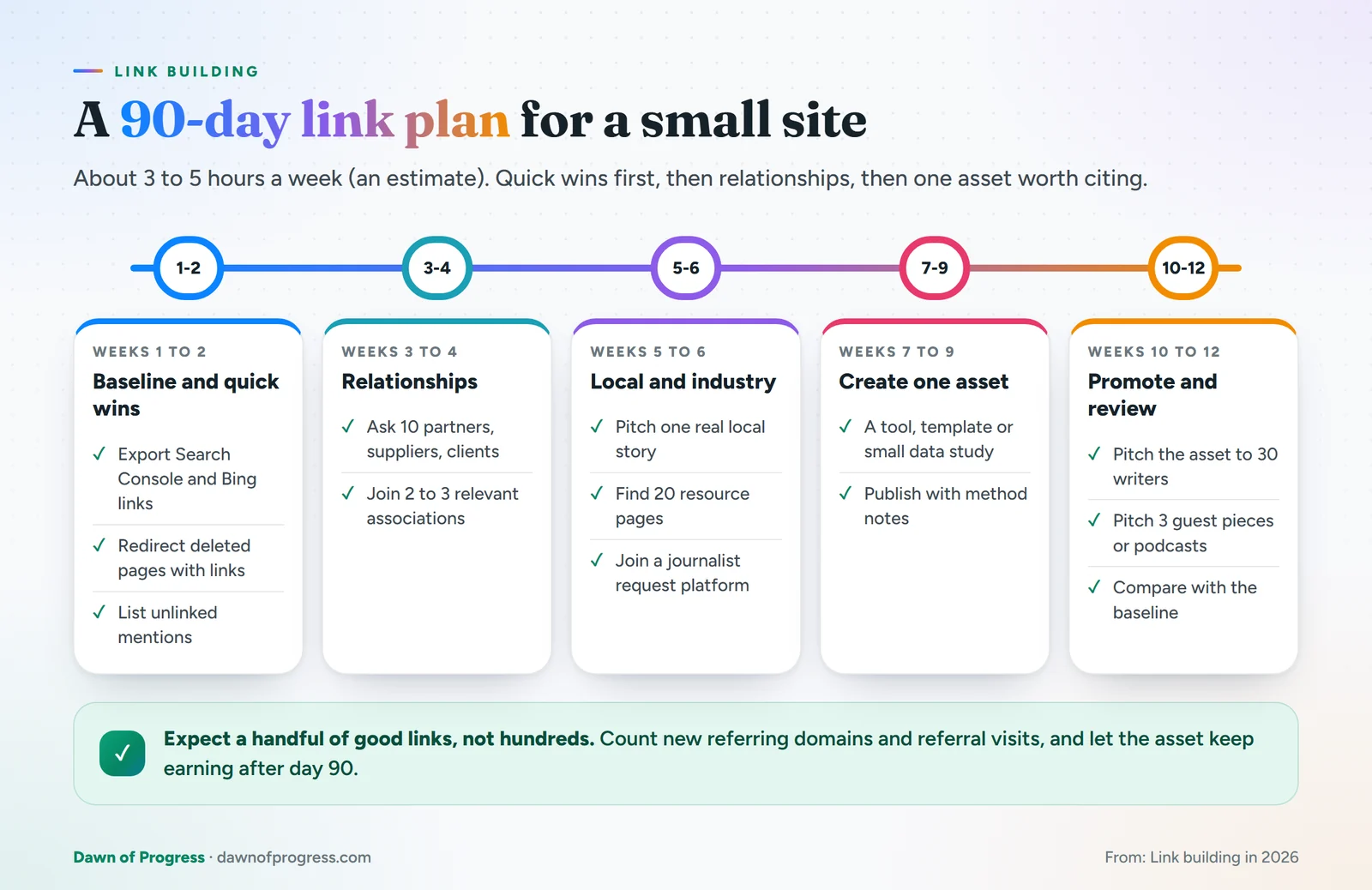
This plan assumes about 3 to 5 hours a week (an estimate; adjust to your time). Fix the basics first: indexed pages, a clear site structure and good internal linking, so the links you earn have somewhere useful to land.
| Weeks | Focus | Tasks | Done when |
|---|---|---|---|
| 1 to 2 | Baseline and quick wins | Export Search Console and Bing link data; redirect deleted pages that have links; list unlinked mentions | Baseline sheet saved; lost links fixed |
| 3 to 4 | Relationships | Ask 10 partners, suppliers and clients; join 2 to 3 relevant associations or directories | Partner list contacted |
| 5 to 6 | Local and industry | Pitch local news with one real story; find 20 resource pages; sign up to 1 or 2 journalist request platforms | 20 tailored pitches sent |
| 7 to 9 | Create one asset | Build one tool, template or small data study that answers a real question in your field | Asset published with method notes |
| 10 to 12 | Promote and review | Pitch the asset to 30 relevant writers; pitch 3 guest pieces or podcasts; compare with the baseline | New referring domains and referral visits recorded |
Expect a handful of good links from this, not hundreds. For a small site, five relevant referring domains in a quarter is a solid start (an estimate from my client work, not a benchmark). The asset keeps earning after the 90 days end. If you want the full picture of where links fit, see my guide to SEO for small business.
What are the most common link building mistakes?
- Building links before the site deserves them. Thin pages don’t keep links or convert visitors. Fix content first.
- Chasing metrics instead of relevance. A high authority score on an unrelated site does little.
- Pointing every link at the homepage. Your guides, tools and service pages need links too, then internal links pass value on.
- Sending templates unchanged. Editors delete obvious mass emails.
- Over-optimizing anchor text. Let most links use your brand or the page title.
- Ignoring trust. Real authors, reviews and credentials make people willing to link. See what E-E-A-T is.
Frequently asked questions
Does link building still work in 2026?
Yes, when links are earned from relevant sites. Google still uses link analysis and PageRank in its core ranking systems, but it ignores or penalizes manipulative links, so quality and relevance matter far more than quantity.
Can you give an example of link building?
A local accountant publishes a free tax deadline calendar for small businesses. The chamber of commerce adds it to its member resources, and a local news site links to it in a story about deadlines. Those are two earned, relevant links.
What are the different types of links?
Backlinks come from other sites, internal links connect pages on your own site, and outbound links point from your site to others. Links can be followed (no rel value) or qualified with rel="nofollow", "sponsored" or "ugc".
How much does link building cost?
Doing it yourself costs mainly time, roughly 3 to 5 hours a week for a small site (an estimate). Agency prices vary widely. Be careful with any service that sells a price per link, because links paid for ranking credit break Google’s spam policies.
How many backlinks do I need to rank?
There is no fixed number. Compare the referring domains of the pages already ranking, and focus on relevance rather than a target count.
Is guest posting still white hat?
Yes, when you write for a real audience on a relevant site and link naturally. It becomes link spam when it’s done at scale with keyword-rich anchors mainly for the link.
Should I disavow toxic backlinks?
Usually no. Google ignores most spam links automatically. Disavow only after a manual action for unnatural links, or if you know paid links were built for your site.


