
Last updated: November 2026. Written by Syed Usman Riaz.
Long-tail keywords are specific searches that each get few searches a month, such as “emergency plumber for a burst pipe at night” instead of “plumber”. What makes a keyword long-tail is its specificity and low individual volume, not its word count. They are easier to rank for, they show exactly what the searcher wants, and together they make up a large share of all searches: Google says 15% of the searches it sees every day are new. You can find them for free in Google’s own results, Search Console, forums, customer emails and AI assistants, as long as you check the ideas against real data.
This guide is a deep dive from my main keyword research guide. That guide covers the whole process. This one covers only long-tail keywords: what they are, how to find them, which to pick and where to put them.
Key takeaways
- Long-tail means specific, not long. A one-word part number can be long-tail; “how to lose weight” is not. Judge by volume and specificity.
- Target them because they convert and rank. Specific searches come from people who know what they want, and big sites rarely write for them.
- Most long-tail keywords don’t need their own page. If the results match a bigger topic, answer them as a section or FAQ on that page.
- Your best source is free. Search Console already shows the long-tail searches your pages appear for. Filter it with regex.
- AI ideas need checking. Use ChatGPT, Gemini or Claude to brainstorm, then confirm each idea in Google’s results or a keyword tool.
What are long-tail keywords?
A long-tail keyword is a narrow, specific search that each month gets a small number of searches compared with the broad topic it belongs to. “Running shoes” is a broad topic. “Running shoes for flat feet women” is a long-tail keyword inside it.
Many guides say long-tail keywords are “three or more words”. That is a rough habit, not the definition. Two tests work better:
- Specificity: does the search describe a precise need, product, problem or place? “Waterproof hiking boots wide fit” is specific. “Best shoes” is three words long and still vague.
- Individual volume: compared with its parent topic, does it get few searches each month? A one-word search for a rare thing, like a niche part number, is long-tail. A four-word search like “how to lose weight” is a high-volume head term.
So word count is a symptom, not the cause. Longer searches tend to be more specific, which is why the two usually go together.
Long-tail keyword examples
| Broad (short-tail) | Long-tail version | What the long-tail search tells you |
|---|---|---|
| plumber | plumber for burst pipe at night | Urgent, ready to call now |
| wedding cake | two-tier wedding cake for 40 guests price | Comparing prices, near a decision |
| accounting software | free invoicing software for freelancers UK | Clear user, budget and country |
| yoga | gentle yoga for lower back pain beginners | Specific problem and skill level |
| WordPress | WordPress site slow after updating plugins | A problem to fix today |
| candles | soy candle tunnelling how to fix | One question, one answer |
What is the “long tail” in search, and where does the name come from?
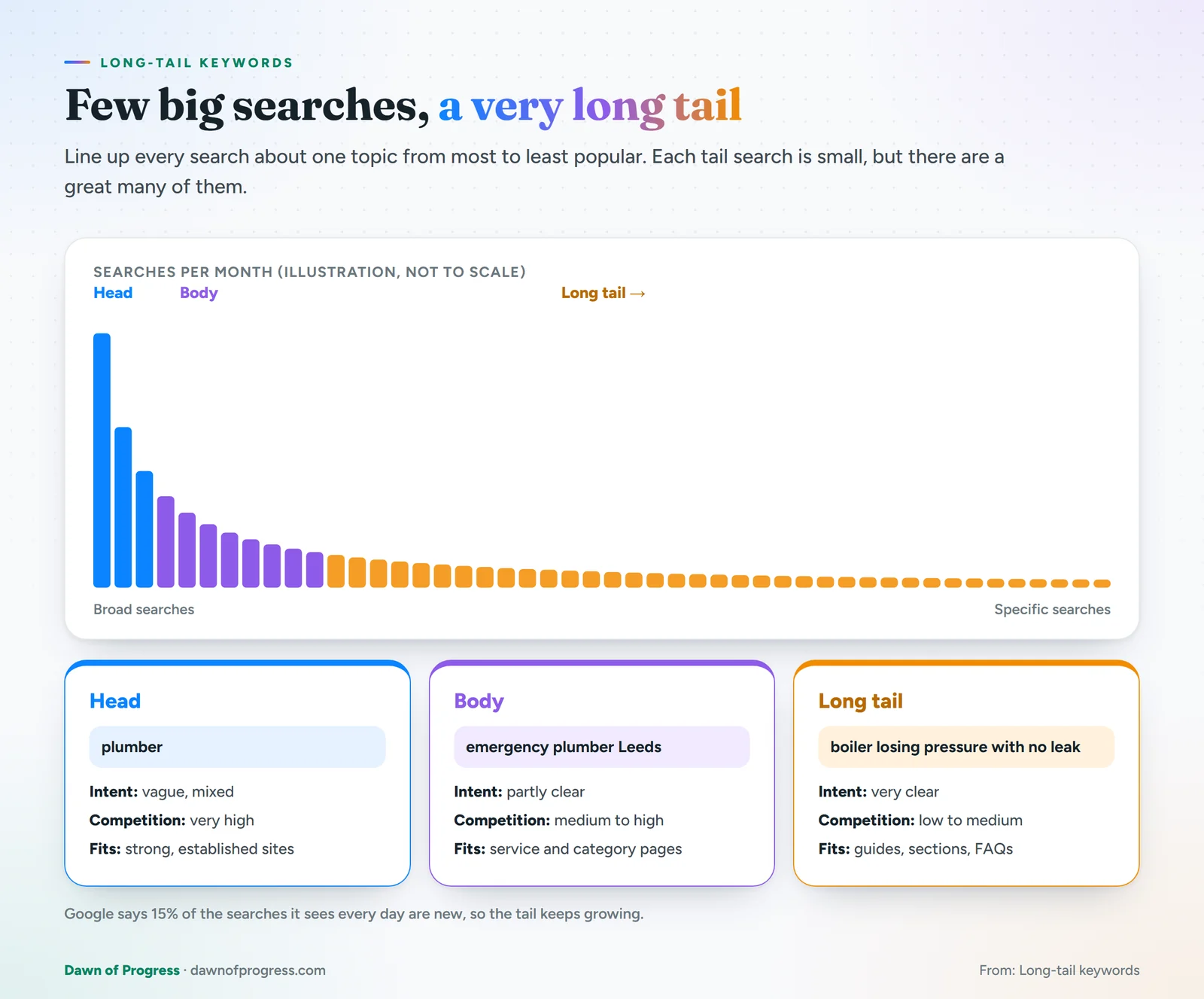
The name comes from the shape of a demand curve. Line up every search about a topic from most to least popular. A few broad searches sit at the top with huge volume: that is the head. Below them are mid-volume searches of two or three words: the body (often called the middle or chunky middle). After that comes a very long line of specific searches, each with tiny volume: the tail. Drawn as a chart, it looks like a tall spike with a long, flat tail stretching to the right.
The idea became popular through Chris Anderson’s 2004 Wired article and 2006 book The Long Tail, which described how online stores sell a little of a huge number of products. Search works the same way. Each long-tail search is small on its own, but there are so many of them that together they can add up to a large share of all searches.
How large? Be careful with the numbers you read. Google itself says that “15% of searches we see every day are new”, which means a steady stream of searches nobody has typed before. Third-party tool studies often claim that the vast majority of keywords get only a handful of searches a month; those figures come from each tool’s own database and are estimates, not Google data. The safe conclusion: the tail is big, it keeps growing, and no tool can see all of it.
Why do long-tail keywords matter for SEO?
Long-tail keywords matter because they are the fastest route to traffic that turns into customers, especially for small and new websites. Four reasons:
- Clear intent. Someone searching “boiler” could want anything. Someone searching “boiler losing pressure no leak” has a specific problem and will likely call whoever explains it best. If search intent is new to you, read my search intent guide.
- Easier to rank. National brands and big publishers write for the head terms. Very specific questions are often answered by forum threads, outdated posts or nothing useful at all, which leaves room for a small site.
- Better conversion. Specific searches usually come from people further along in their decision. In my client work since 2014, the pages that brought enquiries were rarely the ones with the biggest keywords; they were the ones that answered a precise question well.
- They add up. One page that answers a topic thoroughly can appear for dozens or hundreds of long-tail variations. Ten searches a month each, across many variations, becomes real traffic.
One caution: long-tail does not automatically mean easy. Always look at the actual results before you decide.
Head vs body vs long tail: what is the difference?
The three groups differ in volume, competition and how clearly they show intent. The volume ranges below are rough estimates for a typical English-speaking market and change a lot by country and industry; treat them as a guide, not a rule.
| Head | Body (middle) | Long tail | |
|---|---|---|---|
| Typical volume (estimate) | Thousands to millions a month | Hundreds to low thousands | Zero to a few hundred |
| Typical length | 1 to 2 words | 2 to 3 words | 3+ words, often a full question |
| Intent | Vague, mixed | Partly clear | Very clear |
| Competition | Very high | Medium to high | Low to medium |
| Conversion | Low | Medium | Usually highest |
| Best for | Established, strong sites | Category and service pages | New sites, guides, FAQs, specific service pages |
Here is how that looks for three different businesses:
| Business | Head | Body | Long tail |
|---|---|---|---|
| Local plumber | plumber | emergency plumber Leeds | why is my boiler losing pressure with no leak |
| Online candle shop | candles | soy candles | how to stop a soy candle tunnelling |
| Freelance bookkeeper | bookkeeping | bookkeeping for small business | do I need a bookkeeper as a sole trader in the UK |
The head term is out of reach for a small business. The body term fits a service or category page. The long-tail term fits a guide, section or FAQ the business can answer better than anyone.
What is the difference between topical and supporting long-tail keywords?
Not every long-tail keyword needs its own page. A useful split, popularised by the Ahrefs team, is between two kinds:
- Topical long-tail keywords are specific topics in their own right. The results for them are different from the results for the broader term, so they need their own page. Example: “how to stop a soy candle tunnelling” shows how-to guides, while “soy candles” shows shops. Different intent, different page.
- Supporting long-tail keywords are just different wordings of a bigger topic. The results are much the same as for the main keyword, so one good page ranks for all of them. Example: “soy candles uk”, “buy soy candles online” and “natural soy wax candles” all show the same shop pages.
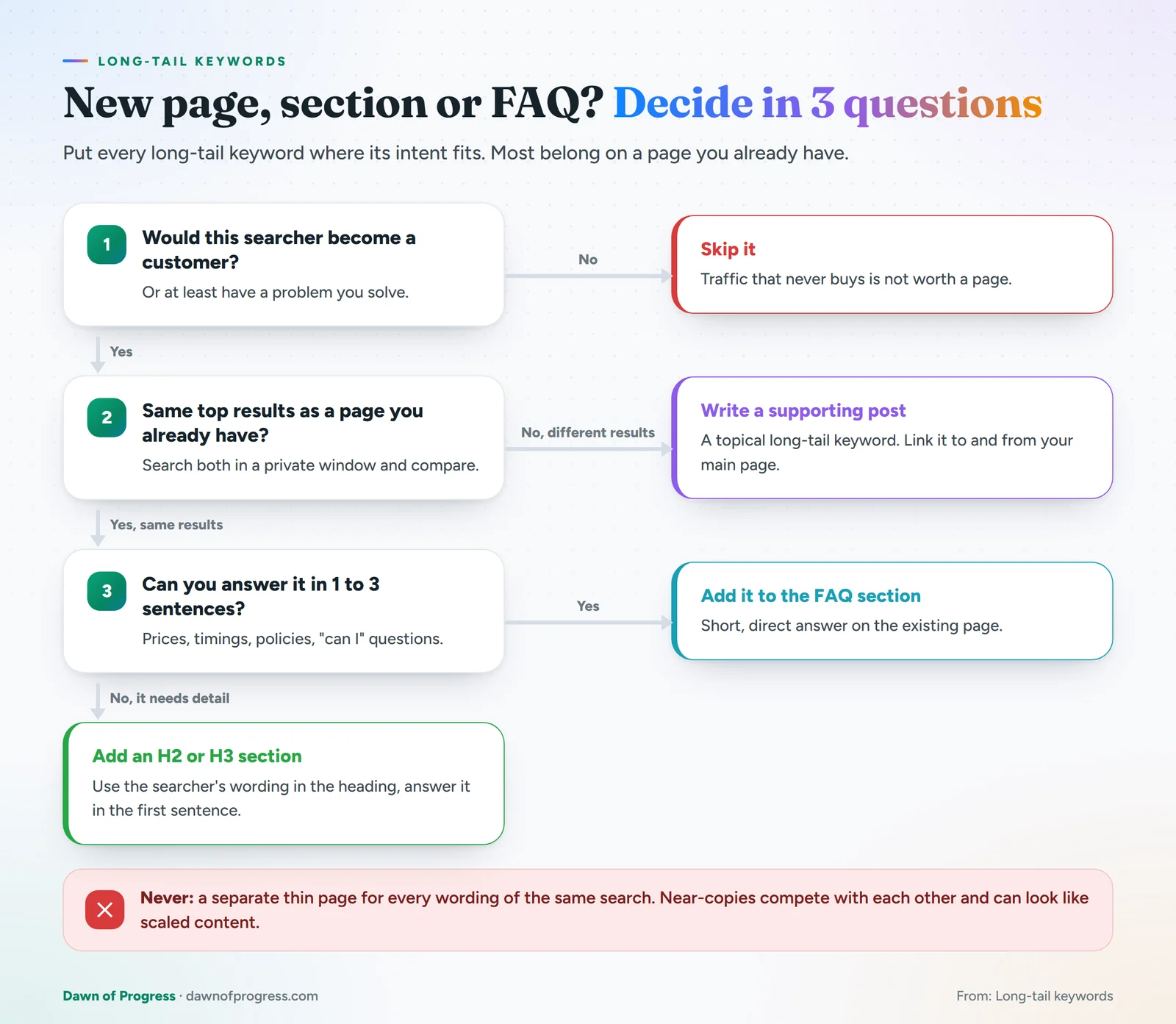
The test takes two minutes. Search the long-tail phrase and its broader parent in a private window. If most of the top results are the same pages, it is supporting: add it to the parent page. If the results are different, it is topical: give it its own page. I explain this “same results” test in more detail in the keyword research guide.
How do you find long-tail keywords for free?
You can find more long-tail keywords than you can ever use without paying for a tool. These ten methods cover different sources: Google’s own suggestions, your own site’s data, real conversations and AI. Use at least one from each group.
1. Google autocomplete
Type your topic into Google slowly and note every suggestion. Then add a space and each letter of the alphabet (“soy candle a”, “soy candle b”), and try question words in front (“how soy candle”, “why soy candle”). Autocomplete reflects real searches, so the suggestions are in your customers’ words. Use a private window so your own history doesn’t change the list.
2. People Also Ask
The People Also Ask box shows questions related to your search. Click one and more questions load underneath. Five or six clicks can give you twenty questions, each a long-tail keyword with clear intent. Copy the ones you could answer better than the current results.
3. Related searches
Scroll to the bottom of the results page. The related searches show how people refine or rephrase the topic. Click one and look at its own related searches to go deeper into the tail.
4. Google Search Console queries (with regex)
This is the best free source, because it shows long-tail searches your site already appears for. In the Performance report, click + Add filter, choose Queries, then Custom (regex), and paste a pattern. Search Console uses RE2 regex syntax, and matching is not case-sensitive by default (Search Console Help).
To find question searches:
^(how|what|why|when|where|which|who|can|does|do|is|are|should)\bTo find long searches of six words or more:
(\S+\s+){5,}\S+Sort the results by impressions. Questions with many impressions but few clicks, or an average position between about 8 and 20, are your quick wins: the page is close, it just needs a clearer answer or a dedicated section. My Google Search Console guide explains the rest of the report.
5. Google Keyword Planner
Keyword Planner is free inside Google Ads, though you need to finish account setup, including billing details (Google Ads Help). Use Discover new keywords, enter your topic and scan the ideas for specific phrases. It often shows nothing for very specific searches; “no data” doesn’t mean nobody searches it.
6. Reddit, Quora and niche forums
Search site:reddit.com your topic or browse the forums your customers use. Read the post titles and the questions inside comments. People write to forums when search didn’t answer them well, so these are often gaps. Note the exact wording, then check whether people also search it on Google.
7. Bing and Bing Webmaster Tools
Bing has its own autocomplete and related searches, often slightly different from Google’s. Bing Webmaster Tools also has a free Keyword Research tool with question and related keyword suggestions. Bing data feeds Microsoft Copilot, so it is a useful second view.
8. AnswerThePublic
AnswerThePublic arranges autocomplete data into questions, prepositions (“candles for”, “candles without”) and comparisons (“candles vs”). The free plan allows a limited number of searches a day, which is enough for a few core topics. It shows wording, not reliable volume, so check the best ideas elsewhere.
9. Your customer emails, sales calls and reviews
Your inbox is a long-tail keyword list nobody else has. Go through enquiry emails, chat messages, call notes and reviews from the last few months and copy every question exactly as written. “Can you fix a combi boiler on a Sunday?” is both a sales question and a search. Ask your team what they get asked every week. This is the source I trust most for small businesses, because these questions come from people who actually paid.
10. AI assistants (for ideas, then verify)
ChatGPT, Gemini, Claude and Copilot are fast at brainstorming the questions a type of customer might ask. They are poor at telling you search volume, and they sometimes invent phrases nobody searches. Use them for ideas only. A prompt that works:
You are helping a [type of business] in [city/country].
List 40 specific questions their customers might type into Google
or ask an AI assistant before buying [service/product].
Group them by stage: problem, comparing options, ready to buy.
Use plain customer language, not industry jargon.
Do not invent search volumes.
Then verify: paste the best ideas into Google to see whether autocomplete or People Also Ask confirms them, check Keyword Planner or Bing, and look for them in Search Console. More AI uses are in my AI SEO workflow, and the other free options are listed in my free SEO tools guide.
How do you choose which long-tail keywords to target?
Choose long-tail keywords by business value first, ability to win second and volume last. With long-tail keywords, volume is often too small for tools to measure, so a “0” in a tool is not a reason to skip a valuable question.
Score each candidate on four questions:
- Would this searcher become a customer? Score 3 if they are ready to buy what you sell, 2 if they have a problem you solve, 1 if the topic is only loosely related.
- Can you answer it better than page one? Search it. If the results are forum threads, thin posts or pages that miss the point, there is room. If they are excellent, specific guides from strong sites, move on.
- Is it topical or supporting? Run the same-results test from above. That decides whether it needs a page or a section.
- Is there any sign of demand? Autocomplete, People Also Ask, a forum thread, a customer email or a Search Console impression all count. You need at least one.
| Example keyword | Value | Can win? | Type | Decision |
|---|---|---|---|---|
| boiler losing pressure no leak | 3 | Yes, forum answers rank | Topical | New guide |
| emergency plumber Leeds Sunday | 3 | Yes | Supporting | Add to the emergency page |
| how does a boiler work | 1 | No, big sites | Topical | Skip |
| combi boiler pressure too high | 2 | Yes | Supporting (same results as the first) | Section in the pressure guide |
How should you use long-tail keywords on your site?
Put each long-tail keyword where it fits its intent: on an existing page, in an FAQ section or in a new supporting post. Creating a separate page for every variation is the most common long-tail mistake, and it can hurt you.
Option 1: add it to an existing page
Use this for supporting long-tail keywords. Add a short H2 or H3 that uses the searcher’s wording, answer the question in the first sentence, and add detail below. For a service page, this might be a “Do you work on Sundays?” section. My on-page SEO guide covers headings and placement.
Option 2: add it to an FAQ section
Use this for short, factual questions that need one to three sentences: prices, timings, policies, “can I” questions. Group them at the end of the relevant page. Write them for readers, not for rich results: Google stopped showing FAQ rich results in 2026.
Option 3: write a supporting post
Use this for topical long-tail keywords where the results show full guides and the answer needs real depth: steps, photos, a comparison. Link the new post to your main service or category page, and link back from that page to the guide. My internal linking guide shows how to build that hub-and-spoke structure.
Avoid thin pages for every variation
“Plumber Leeds”, “plumber in Leeds”, “Leeds plumbing services” and “best plumber Leeds” are one intent. Four near-identical pages compete with each other and give Google nothing new. Google’s spam policies treat many low-value pages made mainly to rank, by people or by AI, as scaled content abuse. One strong page beats twenty thin ones.
How do long-tail keywords work in AI search?
AI search makes long-tail thinking more important, because people talk to AI tools in full sentences. Google reported in May 2026 that “the average AI Mode search is triple the length of a traditional Search query”. A person who once typed “soy candle tunnelling” now asks “my soy candle keeps burning a hole down the middle, how do I fix it without wasting the wax?”
Three things change:
- Prompts are longer and more personal. They include context: budget, location, experience level, what they already tried. You can’t target each prompt as a keyword, because most are unique. You can cover the situations behind them.
- AI tools break questions into smaller searches. Google calls this query fan-out. One prompt about choosing a bookkeeper may trigger searches about cost, sole-trader rules and software. Pages that answer those specific sub-questions clearly have more chances to be used.
- Passages compete, not just pages. A clear section that answers one long-tail question in its first sentence is easy for an AI system to quote.
So the practical advice is the same as for classic search, with more discipline: answer specific questions directly under question-style headings, include the context people mention (who it suits, cost ranges, time, location), and keep facts current. For the full picture, see my LLM SEO guide.
Worked example: long-tail keywords for a small dog grooming salon
Here is how I would approach a small, made-up example: a two-person dog grooming salon in a mid-sized UK town with a basic five-page website. The keywords and decisions below are illustrative, not data from a real client.
Step 1: start from customers, not tools. The owners list the questions they hear every week: “How often should a cockapoo be groomed?”, “Can you groom an anxious dog?”, “Do you do nail clipping only?”, “How long does a full groom take?”
Step 2: expand with Google. Autocomplete for “cockapoo grooming” adds “cockapoo grooming styles”, “cockapoo puppy first groom age” and “cockapoo grooming cost uk”. People Also Ask adds “Should I shave my cockapoo in summer?”
Step 3: check Search Console. The question regex shows the home page already gets impressions, but almost no clicks, for “how often should a cockapoo be groomed”. That proves demand even though Keyword Planner shows no data for it.
Step 4: run the same-results test.
- “Nail clipping only dog groomer [town]” shows local salon pages, the same as “dog groomer [town]”. Supporting: add a section to the services page.
- “Puppy first groom age” shows guides, not salons. Topical: write a guide.
- “Grooming an anxious dog” shows guides and some salon pages. Topical: write a guide that ends with how the salon handles nervous dogs.
Step 5: build the plan.
| Page | Long-tail keywords it covers | Type |
|---|---|---|
| Services page (existing) | nail clipping only, how long a full groom takes, prices by size | Sections and FAQs |
| New guide: “Your puppy’s first groom” | puppy first groom age, what happens at a first groom, how to prepare | Supporting post |
| New guide: “Grooming an anxious dog” | groomer for nervous dogs, can you groom an anxious dog | Supporting post |
| New guide: “How often should a cockapoo be groomed?” | cockapoo grooming frequency, cockapoo summer shave, cockapoo grooming styles | Supporting post |
Three new guides and one improved page cover around fifteen long-tail searches, each linked to the booking page. No thin “groomer near [every village]” pages. For a wider plan, see my SEO for small business guide.
What are the most common long-tail keyword mistakes?
- Defining long-tail by word count. A long phrase can still be vague and highly competitive. Judge specificity and volume.
- Skipping keywords that show zero volume. Tools miss much of the tail. If a customer asked it or Search Console shows impressions, it is real.
- Creating a page for every variation. Supporting keywords belong on one page. Separate thin pages compete with each other and look like scaled content.
- Trusting AI keyword lists blindly. AI assistants guess. Verify every idea in Google’s results or a keyword tool before writing.
- Chasing questions you can’t profit from. A popular question unrelated to what you sell brings visitors who never buy.
- Stuffing the exact phrase. Google understands meaning. Use the natural wording once in a heading or opening sentence, then write for the reader.
Frequently asked questions
What is an example of a long-tail keyword?
“Gentle yoga for lower back pain beginners” is a long-tail version of “yoga”. It is specific, has a clear intent, and gets far fewer searches than the broad term.
How many words is a long-tail keyword?
Usually three or more, but word count is not the definition. A long-tail keyword is defined by being specific and having low individual search volume compared with its broader topic.
Are long-tail keywords easier to rank for?
Usually, because fewer strong sites target them. Not always, though: some specific searches still show strong pages, so check the results before choosing.
What is the difference between short-tail and long-tail keywords?
Short-tail (head) keywords are broad, high-volume and highly competitive, like “plumber”. Long-tail keywords are specific, low-volume and clearer in intent, like “plumber for burst pipe at night”.
How do I find long-tail keywords for free?
Use Google autocomplete, People Also Ask, related searches, Search Console’s query report with a regex filter, Keyword Planner, Bing, forums, AnswerThePublic, your customer emails and AI brainstorming checked against real data.
Should every long-tail keyword get its own page?
No. If a long-tail keyword shows the same results as a broader term, cover it on that page. Give it a page only when the results and intent are different.
Do long-tail keywords still matter with AI search?
Yes, more than before. People ask AI tools long, specific questions, and AI systems pull passages that answer specific sub-questions clearly.


