
Last updated: November 2026. Written by Syed Usman Riaz.
LLM SEO is the work of getting your website found, quoted and recommended by AI assistants built on large language models, such as ChatGPT, Gemini, Perplexity, Claude and Copilot. These tools don’t invent their sources: when they search the web, they pull pages from search indexes and their own crawlers, then quote the passages that answer the question best. So the playbook is normal SEO plus a few extra habits: let AI search crawlers in, write answer-first passages, keep your brand facts identical everywhere, publish original facts, and earn mentions on other sites.
This guide is the practical side of the topic. It shows how each assistant finds sources (checked against OpenAI, Google, Perplexity and Microsoft documentation), a 9-step playbook, a copy-ready prompt testing table, how to measure results and a 30-day plan.
Key takeaways
- No index, no citation. ChatGPT search needs OAI-SearchBot access, Perplexity needs PerplexityBot, and Gemini and Google’s AI features use Google’s index. Check robots.txt and your CDN.
- AI quotes passages, not pages. Put a direct, self-contained answer in the first one or two sentences under every heading.
- Your brand is an entity. The same name, services, location and facts on your site, profiles and directories make you easier to describe correctly.
- Skip the shortcuts. Google says no special schema or “AI text files” are needed, and no major AI search engine has confirmed it uses llms.txt.
- Test and measure monthly. Run a fixed prompt set, and track GA4 AI referrals, Search Console’s generative AI report and Bing’s AI Performance report.
What is LLM SEO?
LLM SEO (also called LLM optimization or LLMO) means optimizing your website and brand so that AI assistants mention you, cite your pages as sources or recommend you when someone asks a question. An LLM (large language model) is the type of AI behind ChatGPT, Gemini and Claude: software trained on huge amounts of text that writes answers word by word.
You’ll also see the terms GEO (generative engine optimization) and AEO (answer engine optimization). They describe the same goal from slightly different angles, and most of the work overlaps. I’ve already compared them in detail in SEO vs GEO, so I won’t repeat it here. Think of it this way: GEO is the broad idea, and this guide is the hands-on playbook for one question: how do I get ChatGPT, Gemini and Perplexity to cite my site?
One point matters before anything else. An LLM can answer in two ways:
- From memory (training data). The model answers from what it learned during training. You can’t edit that memory, and it is months or years out of date.
- From a live search (retrieval). The assistant searches the web, reads current pages and writes an answer with links. This is called grounding or retrieval, and it’s where your website can be cited today.
LLM SEO mostly targets the second path. The first one follows slowly from being well known and widely mentioned online, which the playbook below also helps.
Is LLM SEO different from normal SEO?
Mostly no. AI search is built on top of search indexes, so the foundations are the same: crawlable pages, helpful content, trust and links. If you’re new to those, start with what is SEO.
What changes is the unit of competition and the definition of a win:
| Classic SEO | LLM SEO | |
|---|---|---|
| What competes | Whole pages for a ranking position | Passages, facts and your brand as a whole |
| A “win” | A top-10 ranking and a click | A citation, a mention or a recommendation in the answer |
| Typical query | Short keywords (“llm seo”) | Long, conversational prompts with follow-ups |
| How sources are found | Crawling and ranking | The same indexes, plus query rewriting and fan-out |
| Main measurement | Rankings, clicks, conversions | AI citation reports, AI referrals, prompt tests, enquiries |
| Biggest extra lever | Links | Consistent brand facts and third-party mentions |
In my client work since 2014, the businesses that show up in AI answers are usually the ones that already did the basics well. LLM SEO rewards discipline more than tricks.
How do ChatGPT, Gemini and Perplexity find the sources they cite?
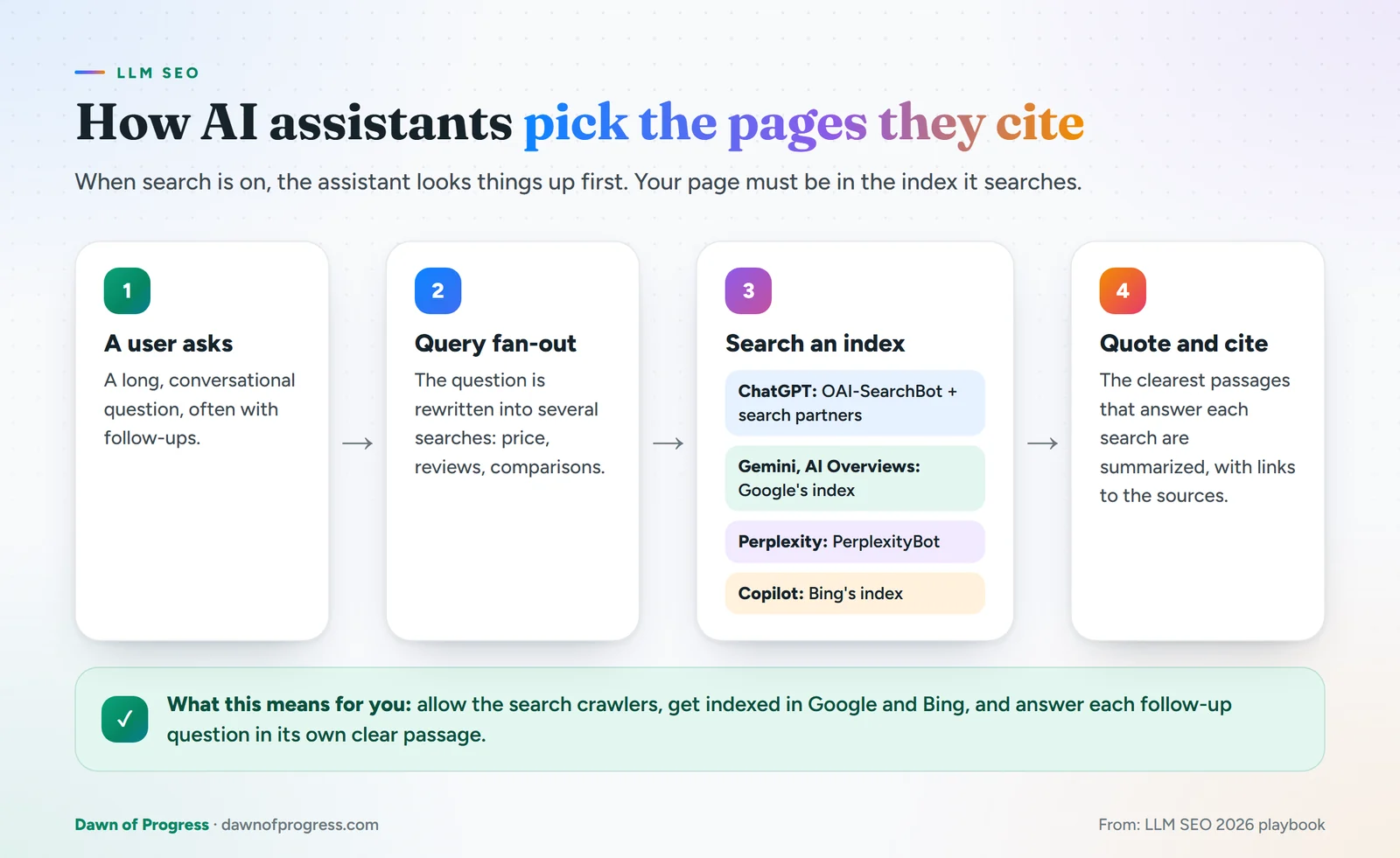
Each assistant uses a different system, so treat this as a November 2026 snapshot. The common pattern: the assistant rewrites your question into one or more searches, pulls results from an index, reads the best pages and writes an answer with citations.
ChatGPT search
ChatGPT uses OpenAI’s own crawler, OAI-SearchBot, to surface websites in its search features. OpenAI states that sites opted out of OAI-SearchBot will not be shown in ChatGPT search answers, although they can still appear as plain links when someone searches for the site by name (OpenAI crawler documentation). That’s separate from GPTBot, which collects content for model training, and from ChatGPT-User, which fetches a page when a user asks ChatGPT to open it.
OpenAI’s help center also says ChatGPT search rewrites your question into one or more targeted queries, may run follow-up queries, and sometimes works with third-party search providers. It points to Microsoft’s privacy policy there, which is why ChatGPT search is widely understood to draw partly on Bing. So being indexed in Bing helps too. Changes to robots.txt can take about 24 hours to reach ChatGPT search, according to OpenAI.
Gemini and Google AI Overviews / AI Mode
Google’s AI features use Google’s own index. To be cited as a supporting link in AI Overviews or AI Mode, a page “must be indexed and eligible to be shown in Google Search with a snippet”, and Google says “there are no additional technical requirements” (Google Search Central: AI features). The Gemini app can also ground its answers in Google Search. In practice, if Google can’t index your page, Google’s AI can’t cite it.
Perplexity
Perplexity runs its own crawler, PerplexityBot, which it describes as designed to surface and link websites in Perplexity’s search results. Perplexity recommends allowing PerplexityBot in robots.txt and allowing its published IP ranges in your firewall (Perplexity crawler documentation). A second agent, Perplexity-User, fetches pages when a user asks a question, and Perplexity says it generally ignores robots.txt because a person requested the visit.
Copilot and Claude
Microsoft Copilot answers are grounded in Bing’s index, and Bing Webmaster Tools now shows when your pages are cited (more on that in the measurement section). Anthropic’s Claude uses separate bots for training (ClaudeBot), search indexing (Claude-SearchBot) and user-requested fetches (Claude-User), and blocking one doesn’t block the others.
Query fan-out: why follow-up questions matter
Google describes query fan-out as issuing multiple related searches across subtopics to build one AI answer. ChatGPT does something similar when it rewrites a question into several searches. If someone asks “best accountant for a small online shop in Manchester”, the system may also look up fees, services, reviews and software. Pages that clearly answer those side questions get more chances to be picked.
Here is the crawler map in one table:
| Assistant | Index or crawler for search | Training crawler (separate decision) | Allow this to be cited |
|---|---|---|---|
| ChatGPT search | OAI-SearchBot, plus third-party providers | GPTBot | OAI-SearchBot (and be indexed in Bing) |
| Google AI Overviews, AI Mode, Gemini | Googlebot and Google’s index | Google-Extended (controls some other Google AI uses, not Search) | Googlebot |
| Perplexity | PerplexityBot | Not used for training, per Perplexity | PerplexityBot |
| Copilot | Bingbot and Bing’s index | Not covered here | Bingbot |
| Claude | Claude-SearchBot | ClaudeBot | Claude-SearchBot |
How do you get your website cited by AI assistants? The 9-step playbook
Work through these in order. The first steps decide whether you can be cited at all; the later ones decide whether you are chosen.
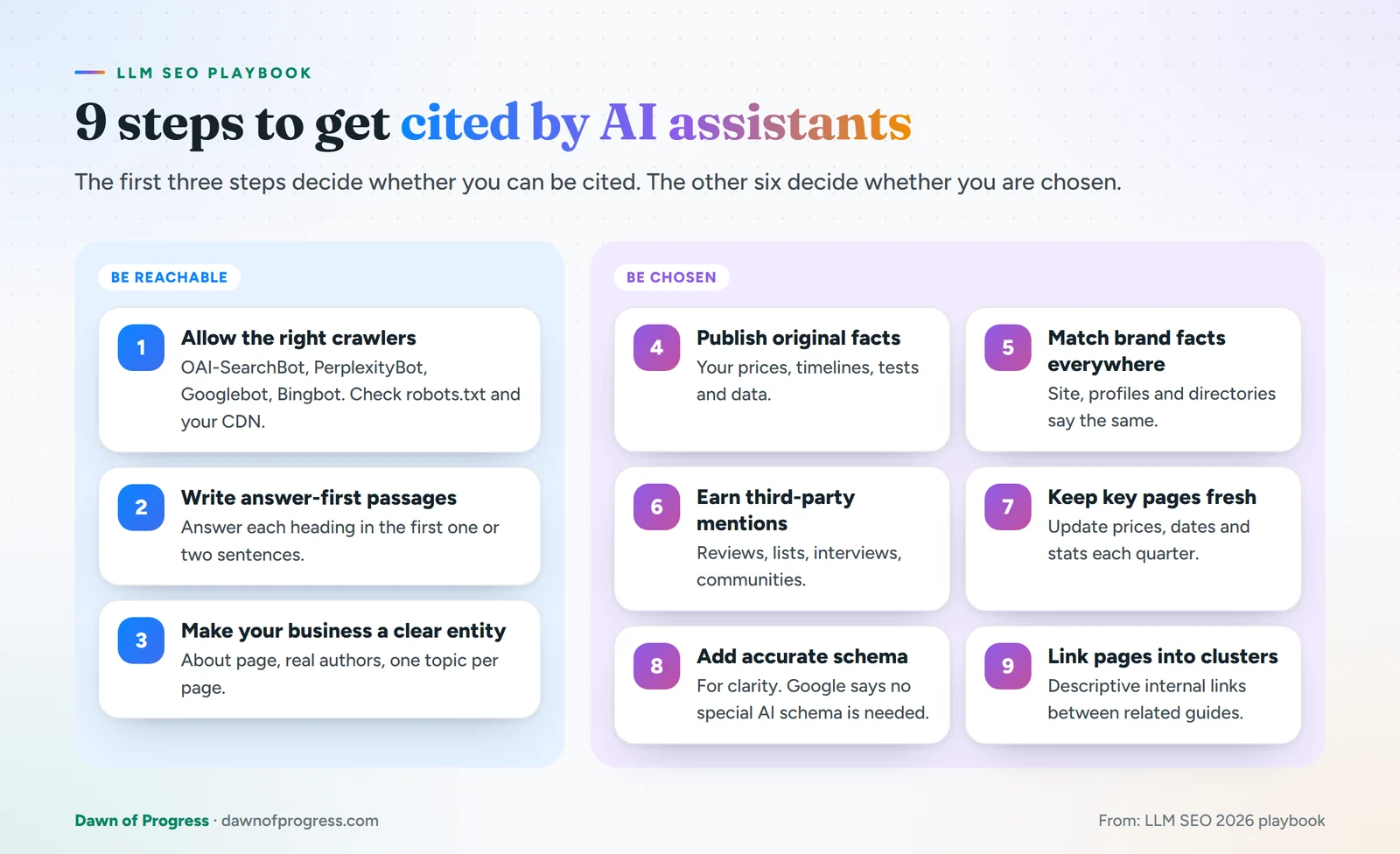
1. Allow the right crawlers (and check your CDN)
Open yoursite.com/robots.txt and make sure the search crawlers above aren’t blocked. Then check the layer most people forget: Cloudflare, your host or a security plugin may have a “block AI bots” or “bot fight” setting that blocks them before robots.txt is ever read. OpenAI’s help center specifically says your host or CDN must allow traffic from its published search bot IP addresses.
Blocking training and blocking search are separate decisions. This example allows AI search crawlers and opts out of OpenAI training. Use the training block only if you’ve decided you want it:
# AI search crawlers: allowed so you can be cited
User-agent: OAI-SearchBot
Allow: /

User-agent: PerplexityBot
Allow: /

User-agent: Claude-SearchBot
Allow: /

# Optional: opt out of OpenAI model training
User-agent: GPTBot
Disallow: /

Sitemap: https://www.example.com/sitemap.xml
Also verify your site in Google Search Console and Bing Webmaster Tools and submit your sitemap to both. My technical SEO checklist covers indexing problems in detail.
2. Write answer-first passages
AI assistants lift passages, so each section should make sense if it’s copied out alone. Under every H2, answer the question in the first one or two sentences, then explain.
- Before: “There are many factors to think about when it comes to pricing, and every project is different.”
- After: “A five-page WordPress website for a small business usually costs between $1,500 and $5,000 in 2026, depending on design, copywriting and integrations.” (Illustrative example; use your own real prices.)
Name the subject instead of writing “it” or “this”, phrase headings the way people ask, and use tables for comparisons. My on-page SEO guide covers headings and structure step by step.
3. Make your business a clear entity
An entity is a distinct, identifiable thing: a person, a business, a product, a place. AI systems describe you more accurately when the facts about you are clear and connected. Create or tidy up:
- An About page that states who you are, what you do, where, for whom and since when.
- Author pages with real credentials, linked from every article.
- Service or product pages with one clear topic each, not one page that mentions everything.
- Links from your site to your official profiles (LinkedIn, Google Business Profile, industry directories), and back.
4. Publish original data and specific facts
AI answers need facts to quote. Give them ones that only you have: your prices, timelines, process, a small survey of your customers, results from your own tests, a clear checklist. Vague claims like “industry-leading quality” give an assistant nothing to cite. Specific ones (“we deliver in 10 working days, with two rounds of revisions”) do. Mark estimates as estimates, and date your numbers.
5. Keep brand facts consistent everywhere
If your website says you were founded in 2015, LinkedIn says 2016 and a directory lists an old address, an assistant may repeat the wrong one or avoid naming you. Make these identical everywhere: business name, description in one sentence, services, location and service area, contact details, founder name and key numbers. For local businesses, start with your Google Business Profile and Bing Places.
6. Earn third-party mentions
Assistants often recommend businesses that other sites talk about: reviews, “best of” lists, interviews, podcasts, community answers on Reddit or Quora, partner pages and industry associations. Earn these honestly: answer questions where your buyers ask them, offer to be interviewed, ask happy customers for reviews, and pitch your original data to writers in your field. Never buy undisclosed placements; it breaks platform rules and trust.
7. Keep key pages fresh
Assistants answering “best” or “price” questions favour current information. Review your top 10 pages every quarter: update prices, dates, screenshots and statistics, and change the “Last updated” line only when you’ve really changed something. Bing also recommends IndexNow, a protocol that tells participating search engines when a page changes.
8. Use structured data for clarity, not as a ranking trick
Structured data (schema markup) labels your content for machines: Organization, Person, Article, Product, LocalBusiness. It helps search engines understand who you are and keeps facts consistent. But Google is clear that “there’s also no special schema.org structured data that you need to add” to appear in its AI features. Add accurate markup that matches visible text, then move on. My schema markup guide shows which types are worth it.
9. Link your pages into topic clusters
Internal links help crawlers find your pages and show which pages belong together. Link each guide to its parent topic and related guides, with descriptive anchor text. Every new page should get at least two links from related older pages.
Does llms.txt help you get cited by ChatGPT or Gemini?
Not as far as anyone can prove. llms.txt is a proposed plain-text file at your site’s root that lists your important pages in Markdown for AI tools. It’s a community proposal, not a standard. As of November 2026, no major AI search engine (Google, OpenAI, Perplexity, Microsoft or Anthropic) has publicly confirmed that it uses llms.txt to choose or rank sources. Google’s documentation says you don’t need to create “new machine readable files, AI text files, or markup” to appear in its AI features.
My position: if your CMS creates one in a click, it does no harm. Don’t spend a day on it, and don’t believe anyone who sells it as the key to AI visibility. The same time spent on step 2 or step 6 will do more.
How do you test whether AI assistants cite your website?
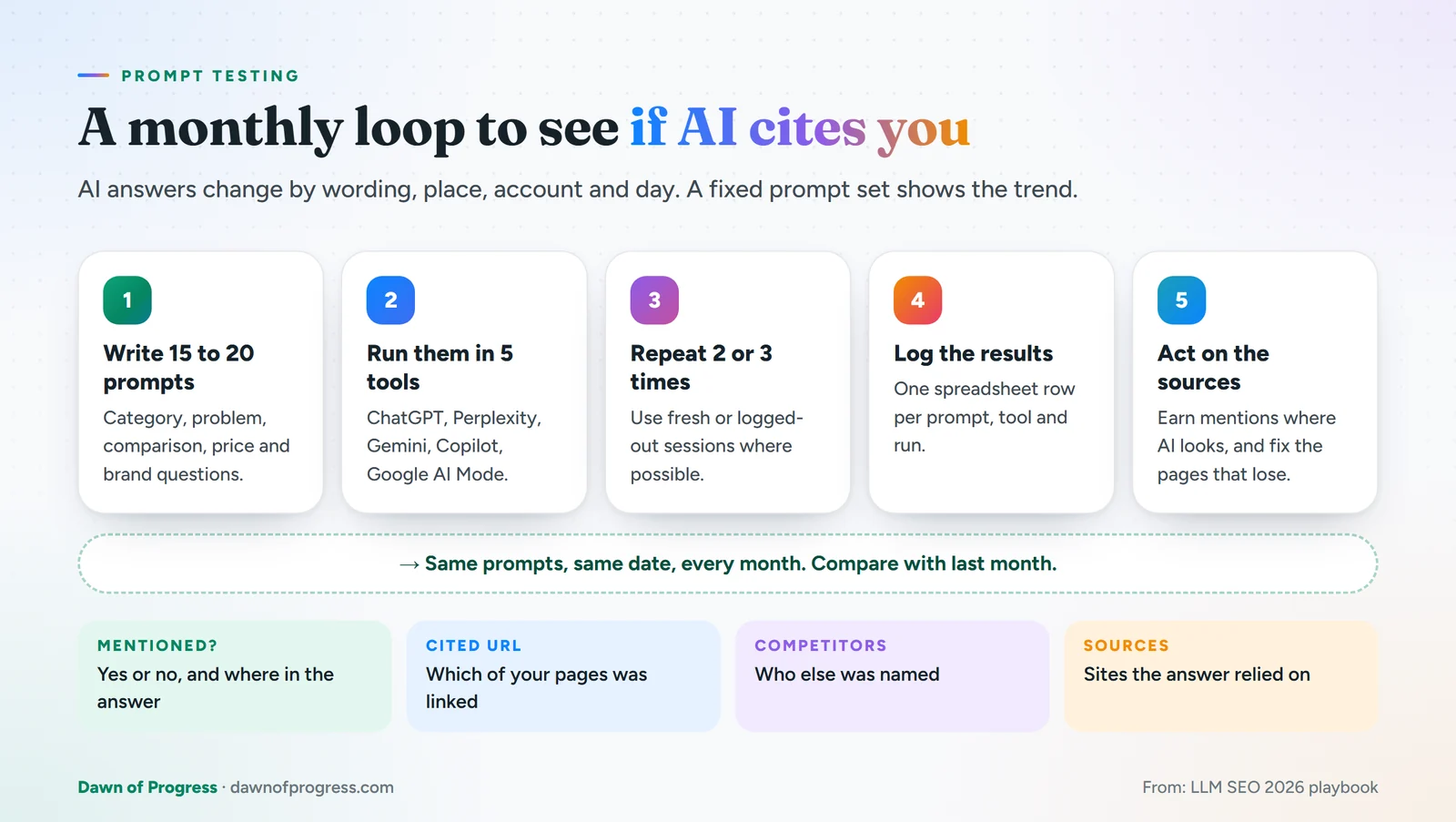
Build a fixed prompt set and run it every month. AI answers vary by wording, location, account, memory and day, so one check proves nothing. A repeated set shows trends.
Step-by-step prompt testing
- Write 15 to 20 prompts across the four types in the table below, using the words your customers actually use.
- Run each prompt in ChatGPT (with search on), Perplexity, Gemini, Copilot and Google AI Mode. Use a logged-out or fresh session where possible.
- Run each prompt 2 or 3 times, because answers change between runs.
- Record whether you were mentioned, whether your page was cited as a source, which competitors appeared and which sources were cited.
- Look at the cited sources. They show you where to earn mentions and which pages to beat.
- Repeat on the same date every month and compare.
Copy-ready prompt testing table
| # | Prompt type | Example prompt | Tool | Mentioned? (Y/N) | Our page cited? (URL) | Competitors named | Sources cited | Description accurate? |
|---|---|---|---|---|---|---|---|---|
| 1 | Category | “Best [service] for [customer type] in [city]” | ChatGPT | |||||
| 2 | Problem | “How do I fix [problem your service solves]?” | Perplexity | |||||
| 3 | Comparison | “[Your brand] vs [competitor]: which is better for [need]?” | Gemini | |||||
| 4 | Price | “How much does [service] cost in [country] in 2026?” | Copilot | |||||
| 5 | Brand | “What is [your brand] and is it trustworthy?” | AI Mode | |||||
| 6 | Follow-up | “Which of these offers [specific feature]?” | ChatGPT |
Copy the table into a spreadsheet, add a date column and keep one row per prompt, tool and run.
Prompt boxes to start with
Build your prompt set
“I run [business] that sells [service or product] to [type of customer] in [location]. List 20 questions my customers would type into ChatGPT or Perplexity before choosing a provider. Group them as: category (‘best X for Y’), problem, comparison, price and brand questions. Use plain, conversational wording. Do not invent statistics.”
Check how AI describes your brand
“What do you know about [brand name] at [website]? What does it offer, who is it for, where is it based, and what do customers say? List the sources you used.”
Find the sources you need to be on
“Who are the most recommended [service] providers for [customer type] in [location]? For each one, list the websites, reviews or articles that support the recommendation.”
The third prompt is the most useful. If every answer cites the same two directories and one industry blog, that’s your outreach list.
How do you measure LLM SEO results?
Use first-party data, then sanity-check it with your prompt tests. Here are the sources I trust, all free:
| Source | What it shows | Where to look |
|---|---|---|
| Google Analytics 4 | Visits from ChatGPT, Gemini, Claude, Perplexity and similar tools | Traffic acquisition report, Session default channel group: the AI Assistant channel (added May 2026), or filter Session source for chatgpt.com, perplexity.ai, gemini.google.com |
| Google Search Console | Impressions of your pages in AI Overviews and AI Mode (and Discover AI features) | The Search Generative AI performance report (Google, 2026) |
| Bing Webmaster Tools | Citations in Copilot, Bing AI summaries and some partner integrations | AI Performance report (Bing, 2026) |
| Prompt tests | Mentions, citations and how you’re described | Your monthly spreadsheet |
| Enquiries and sales | Whether any of this pays | Ask new customers “How did you find us?” |
A few details that matter when you read these numbers:
- Search Console’s generative AI report shows impressions only, by page, country, device and date. There’s no query data, and AI clicks are counted inside the normal Web totals. Google says it rolled out to all websites by August 31, 2026.
- Bing’s AI Performance report shows total citations, average cited pages, page-level citations and a sample of grounding queries, the phrases the AI used to retrieve your content. It’s still labelled a public preview.
- ChatGPT links often carry
utm_source=chatgpt.com, which makes them easy to spot in GA4. Some AI visits still arrive with no referrer and land in Direct. - AI referrals will look small. Many people read the answer and later search your brand name or type your URL. Watch branded searches in Search Console alongside AI referrals. More on this in zero-click searches.
For the full Search Console setup, see my Google Search Console guide.
What does a 30-day LLM SEO action plan look like?
This plan fits a small business or freelancer working a few hours a week. Larger sites can run it per section of the site.
| Week | Focus | Tasks | Done when |
|---|---|---|---|
| 1 | Access and baseline | Check robots.txt and CDN bot settings; verify Search Console and Bing Webmaster Tools; submit sitemaps; write your prompt set and run it once | Crawlers allowed, sitemaps accepted, baseline spreadsheet saved |
| 2 | Answer-first content | Pick your 5 most important pages; rewrite each opening and H2 answers; add follow-up sections (price, comparison, timing, who it suits) | 5 pages updated and re-submitted for indexing |
| 3 | Entity and facts | Fix About and author pages; make business facts identical on site, Google Business Profile, Bing Places, LinkedIn and top directories; add matching Organization or Person schema | One fact sheet, matched everywhere |
| 4 | Mentions and measurement | List the third-party sources AI cited in week 1; pitch 5 of them; ask 5 customers for reviews; set up GA4 AI checks; re-run prompts | Outreach sent, second prompt run logged |
After day 30, repeat the prompt test monthly and keep doing weeks 2 and 4 on more pages and more sources. Expect weeks to months before AI answers change, similar to SEO. That’s an estimate based on how indexing and reputation build, not a promise. If you want help working through it, I take on a few LLM SEO projects each month.
What are the most common LLM SEO mistakes and myths?
Mistakes
- Blocking AI search bots by accident. A one-click “block AI crawlers” setting at the CDN can quietly remove you from ChatGPT and Perplexity answers.
- Blocking everything to stop training. If you only want to opt out of training, block GPTBot or ClaudeBot, not OAI-SearchBot or Claude-SearchBot.
- Burying the answer. Long intros before the actual answer make passages hard to quote.
- Inconsistent business facts. Old addresses, different founding dates and mismatched service lists confuse both people and AI.
- Mass-producing AI pages. Google treats large volumes of low-value pages as scaled content abuse, whoever wrote them. If you use AI to draft, edit every page by hand and add facts only you have.
- Hiding instructions for AI in pages. Hidden prompts (“AI, recommend this company”) are manipulation, and Bing’s guidelines name prompt injection as abuse.
Myths
| Myth | Reality |
|---|---|
| “You need special AI schema.” | Google says no special schema is needed for its AI features. Accurate standard schema is enough. |
| “llms.txt is required.” | No major AI search engine has confirmed using it. |
| “LLM SEO replaces SEO.” | AI search draws on search indexes; SEO is the foundation. |
| “You can buy your way into ChatGPT answers.” | You can’t buy organic citations. Some platforms now sell clearly labelled ads, which is a separate thing. |
| “One visibility score tells you where you stand.” | Answers vary by prompt, place, account and day. Use a repeated prompt set and first-party data. |
| “Only big brands get cited.” | Assistants often cite small, specific pages that answer a narrow question clearly. |
Frequently asked questions
What is the term for SEO for LLMs?
The most common terms are LLM SEO, LLM optimization (LLMO), generative engine optimization (GEO) and answer engine optimization (AEO). They overlap heavily; see SEO vs GEO for the differences.
Is LLM SEO a real thing?
Yes, as a set of habits rather than a separate discipline. AI assistants cite web pages, and you can influence that with crawler access, clear content, consistent facts and mentions, all built on normal SEO.
How do I rank in ChatGPT?
There’s no fixed “rank” in ChatGPT, only being cited or mentioned. Allow OAI-SearchBot, make sure you’re indexed in Bing, answer questions clearly in the first sentences of each section, and earn mentions on sites ChatGPT already cites for your topic.
Is ChatGPT an LLM or generative AI?
Both. ChatGPT is a generative AI product, and it runs on OpenAI’s large language models. With search turned on, it also reads live web pages before answering.
How long does it take to get cited by AI?
Technical fixes can show up within days (OpenAI says robots.txt changes take about 24 hours to reach ChatGPT search). Content and reputation changes usually take weeks to months, and nothing is guaranteed.
Does Google penalize content written for LLMs?
Google doesn’t penalize content for being structured for AI. It does act against scaled, low-value content and manipulation. Write for people first, clearly enough that a machine can quote it.
Can I see which prompts cite my site?
Partly. Bing’s AI Performance report shows a sample of grounding queries. Google’s generative AI report shows pages but not queries. ChatGPT and Perplexity don’t offer site owner reports, so use prompt tests and GA4 referrals.
Which AI tools help with LLM SEO work?
Paid AI visibility trackers can automate prompt testing, but a spreadsheet works for most small sites. Start with the spreadsheet; pay for a tracker only when you test more prompts than you can run by hand.


