
Last updated: November 2026. Written by Syed Usman Riaz.
E-E-A-T stands for Experience, Expertise, Authoritativeness and Trustworthiness. It is the framework Google’s human search quality raters use to judge whether a page is reliable, and Google says its ranking systems look for a mix of signals that line up with it. Trust is the most important of the four. E-E-A-T is not a single score or a direct ranking factor, but on topics that affect health, money or safety, Google gives content with strong E-E-A-T even more weight.
This guide explains what each letter means, where the idea comes from, what Google officially says, and how to show each part on a real website. It ends with a self-audit scorecard you can fill in for your own site in about 30 minutes.
Key takeaways
- Trust is the center. Google says trust is the most important part of E-E-A-T. Experience, expertise and authority all feed into it.
- It is not a score you can see or set. Raters use E-E-A-T to grade test results, and their ratings don’t move your rankings directly. Google’s systems use many signals that align with it.
- Answer Who, How and Why on every important page. Who wrote it, how it was made and why it exists are Google’s own questions.
- Proof beats claims. Bylines that lead to real author pages, first-hand photos and tests, linked sources and real reviews say more than “we are experts.”
- AI content is judged the same way. Google cares about quality and honesty, not whether a tool helped. Fake authors and fake experience are the risk.
What does E-E-A-T stand for?
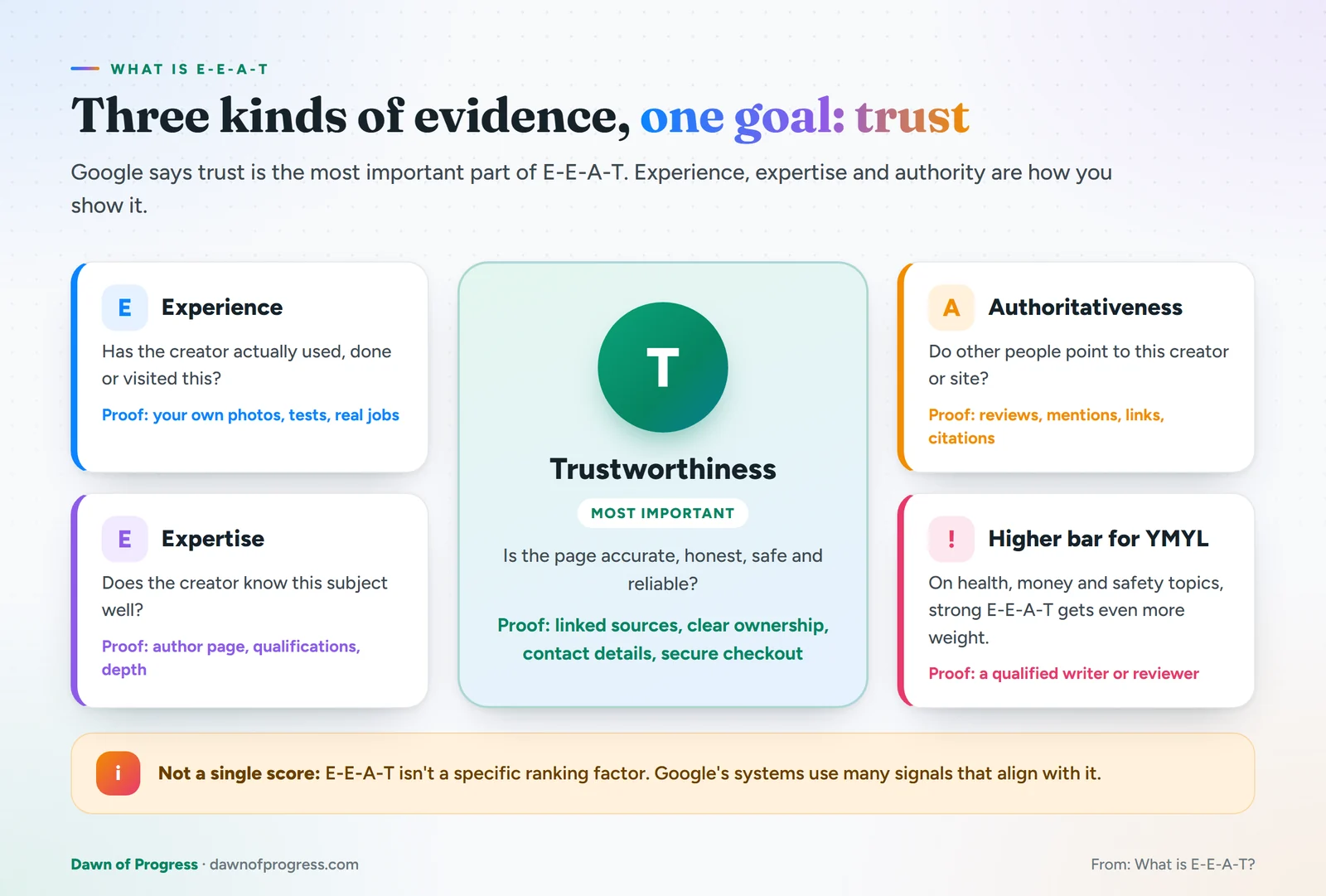
E-E-A-T is an acronym for four qualities Google wants to see in the content and the people behind it. In the rater guidelines overview, Google describes them as the first-hand experience of the creator, the expertise of the creator, the authoritativeness of the creator, content and website, and trust: “the extent to which the page is accurate, honest, safe, and reliable” (Google Search Quality Rating overview).
| Letter | Means | The question it answers | Example of proof |
|---|---|---|---|
| Experience | First-hand, lived contact with the topic | Has the creator actually used, done or visited this? | Your own photos of a product you tested; a renovation diary from a real job |
| Expertise | Knowledge or skill in the topic | Does the creator know this subject well? | A qualified accountant writing about tax; a developer explaining code |
| Authoritativeness | Being a go-to source others recognize | Do other people point to this creator or site? | Mentions in industry press, links from respected sites, citations |
| Trustworthiness | Accurate, honest, safe and reliable | Can a reader rely on this page and this business? | Correct facts with sources, clear ownership, contact details, secure checkout |
The order matters less than the relationship. Think of trust as the target and the other three as the evidence. A page can be trustworthy without a famous author, but it can’t be untrustworthy and still score well, however expert the writer is.
Experience vs expertise: what is the difference?
Experience is having done the thing. Expertise is knowing the subject deeply. A person who has lived with diabetes for 20 years has experience that a textbook can’t give. A doctor has expertise. For a forum post about coping day to day, experience may be exactly what the reader needs. For dosage advice, the reader needs expertise. Good pages often combine both.
Where does E-E-A-T come from?
E-E-A-T comes from Google’s Search Quality Rater Guidelines, a public document of more than 170 pages that tells Google’s human raters how to judge search results. Google works with about 16,000 external raters around the world. They run sample searches, compare results with and without proposed changes, and grade pages on two scales: Page Quality (how reliable the page is, which is where E-E-A-T sits) and Needs Met (how well the result satisfies the search).
Here is the part many articles get wrong. Google states that rater scores “alone will not directly affect how a particular webpage, website, or result appears in Google Search” (Google Search Quality Rating overview). Ratings are used in aggregate to test whether Google’s algorithms are working. No rater visits your site and lowers your ranking.
So why care? Because the guidelines describe what Google’s engineers are trying to make the algorithms reward. When a ranking change makes raters see more trustworthy results, that change is more likely to launch. The guidelines are a map of the target, not the mechanism.
When was Experience added?
The original framework was E-A-T (expertise, authoritativeness, trustworthiness), used in the guidelines for years. On December 15, 2022, Google added a second E for Experience, so the acronym became E-E-A-T (Google Search Central blog, 2022). The change recognized that some of the most useful content comes from people who have personally used a product, visited a place or lived through a situation, even without formal credentials. The guidelines were last refreshed in September 2025 with small clarifications, updated YMYL definitions and examples covering AI Overviews.
What does Google officially say about E-E-A-T?
Google’s main public statement sits in its guide to creating helpful, reliable, people-first content. The key points, in plain English:
- Google’s systems use a mix of factors to identify content that shows experience, expertise, authoritativeness and trustworthiness.
- Of these, trust is the most important.
- E-E-A-T “itself isn’t a specific ranking factor.”
- On YMYL topics, Google’s systems give “even more weight” to content with strong E-E-A-T.
- Raters “have no control over how pages rank,” and rater data is not used directly in ranking algorithms.
- Reading the rater guidelines can help you self-assess your content.
Google’s “Who, How and Why” questions
The same page gives the most practical E-E-A-T test Google has published. Ask three questions about every important page:
- Who created the content? Is it obvious who wrote it? Do pages have bylines where readers would expect them, and do those bylines lead to more information about the author?
- How was it created? For reviews, did you explain how many products you tested, how you tested them and show evidence such as photos? If automation or AI was used in a way readers would wonder about, did you say so and explain how?
- Why was it created? Google calls this “perhaps the most important question.” The answer should be: mainly to help people who come to your site. If the main reason is to attract search traffic, that is the wrong reason, and using automation mainly to manipulate rankings breaks Google’s spam policies.
If you take one thing from this guide, make it these three questions. Every item in the checklist below is a way of answering one of them visibly.
What are YMYL topics, and why do they need stronger E-E-A-T?
YMYL stands for “Your Money or Your Life.” Google uses it for topics that could significantly affect a person’s health, financial stability or safety, or the welfare of society. Raters apply very high Page Quality standards to these pages, because bad information can cause real harm.
| Topic | YMYL? | Why |
|---|---|---|
| Symptoms of a heart attack | Yes | Wrong advice could cost a life |
| How to file taxes as a freelancer | Yes | Mistakes cost money and can bring penalties |
| Choosing a pension or investment | Yes | Financial stability |
| Is this electrical wiring safe? | Yes | Physical safety |
| How to brew pour-over coffee | No | Low risk if the advice is wrong |
| How to write a meta description | No | A mistake costs some clicks, not health or savings |
If your site covers YMYL topics, expertise stops being optional. A personal story about managing debt can be valuable experience, but advice on what to invest in needs a qualified writer or reviewer, clear sources and a visible date. Most small-business sites are a mix: the service pages for a plumber are low risk, while a page on gas safety is not.
Is E-E-A-T a ranking factor?
No, not as a single measurable factor. There is no E-E-A-T score in Search Console, no number you can raise, and no setting to switch on. Google says plainly that E-E-A-T is not a specific ranking factor.
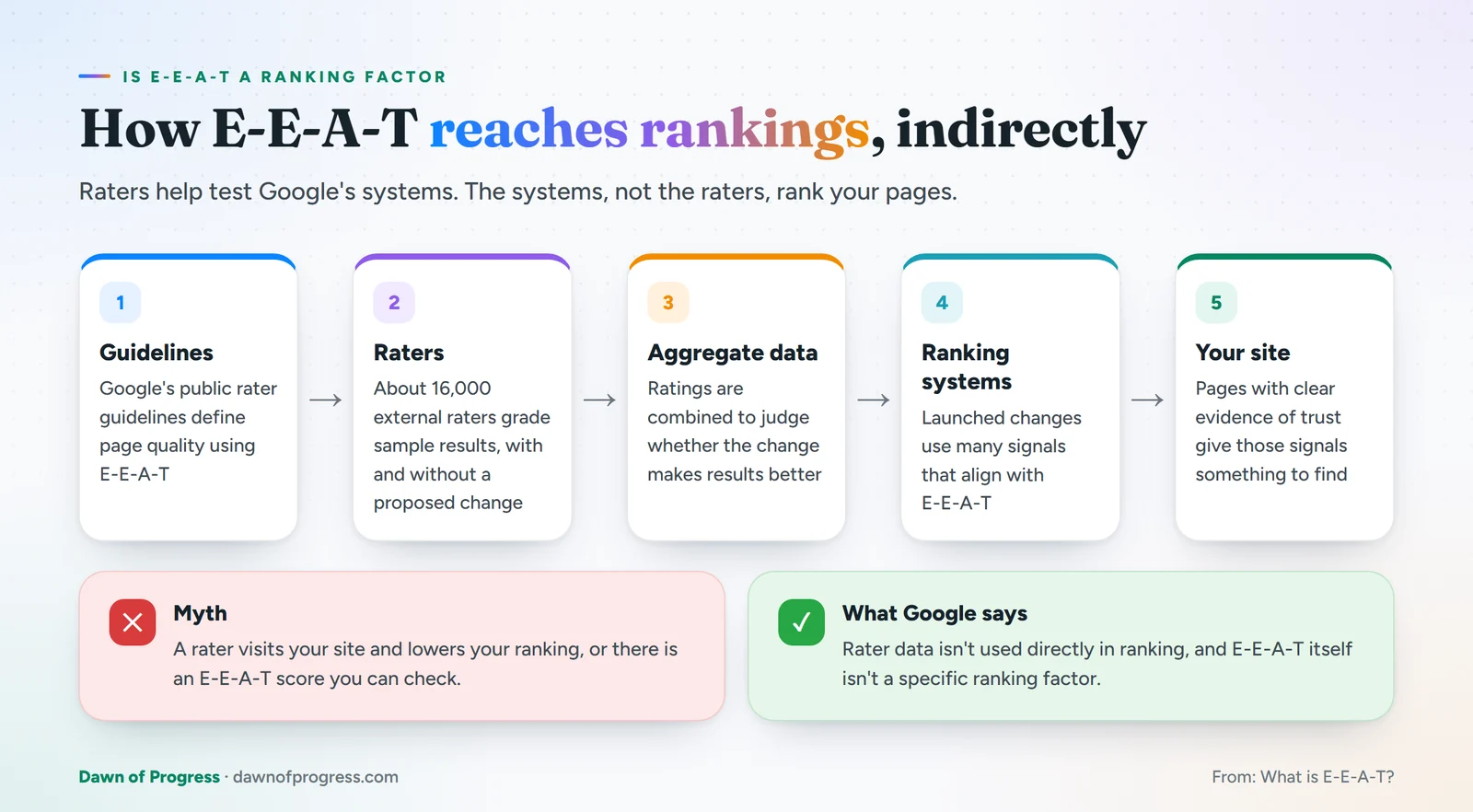
What is true is that Google’s systems look at many signals that align with E-E-A-T. The rater overview gives one example: the number of quality pages that link to a page is a signal that it may be a trusted source. Others are likely to include how well content matches what reliable sources say, how known a site is for its topic, and whether people find what they need. Google doesn’t publish the full list, so treat any article that claims to know the exact signals with caution.
The practical answer for site owners: you can’t optimize for E-E-A-T directly, but you can make the evidence of it easy to find for both readers and machines. That is what the rest of this guide is about. It fits into the wider picture of what SEO is and how it works.
How do you show E-E-A-T on your website? A practical checklist
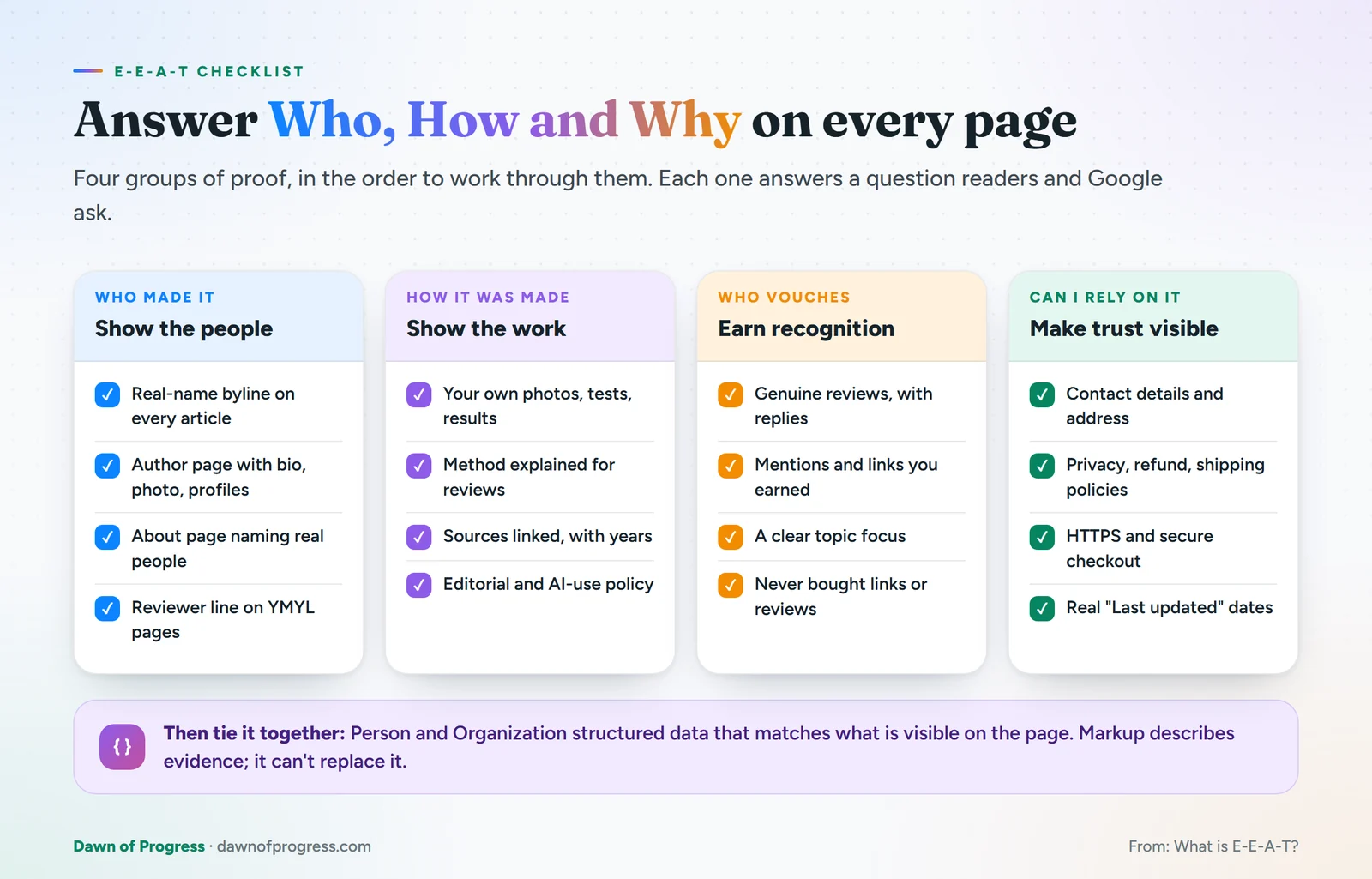
Work through these in order. The first group answers “Who,” the second “How,” the third builds authority, and the last ties it together for machines.
Show who is behind the content (Experience and Expertise)
- Add a byline to every article with the author’s real name, linked to an author page.
- Build a real author page for each writer: photo, short bio, relevant experience in years and type of work, qualifications if they matter for the topic, and links to profiles such as LinkedIn. Keep it factual.
- Write an About page that names real people. Who owns the business, where it is based, how long it has operated and what it actually does.
- Add a reviewer line on YMYL pages, for example “Medically reviewed by [name], [qualification],” but only when that review really happened.
Show how the content was made (Experience and Trust)
- Use first-hand evidence. Your own photos, screenshots, test results, before-and-after images and measurements. A stock photo proves nothing; a photo of your team on a real job proves a lot. Keep them light with good image optimization.
- Explain your method. For reviews and comparisons, say what you tested, for how long and how. For guides, say where the data came from.
- Cite and link your sources. Link statistics to the original study, name the year, and prefer official documentation.
- Publish an editorial policy. One page that explains how you research, fact-check, use AI and correct errors. Link to it from your About page and footer.
- Show dates. A visible “Last updated” date, and actually recheck the facts when you change it.
Earn recognition from others (Authoritativeness)
- Collect genuine reviews on Google, industry platforms and your own site, and reply to them.
- Earn mentions and links through useful resources, interviews, guest talks, partnerships and local press. Never buy them.
- Stay focused. A site known for one topic builds authority faster than one that writes about everything.
Make trust visible (Trustworthiness)
- Make contact easy: a real address or service area, phone number, email and a contact form that works.
- Show your policies: privacy policy, terms, refunds, shipping and returns where relevant.
- Use HTTPS everywhere and a secure checkout for any payment.
- Fix factual errors fast, and say what changed when you correct something important.
- Keep ads and affiliate links clearly labeled, and never let them bury the main content.
Help machines connect the dots (structured data)
- Add Person and Organization structured data that matches what is visible on the page: the author’s name and URL in Article markup, your business name, logo, contact details and social profiles in Organization markup. Google’s Article structured data guidance asks for only the name in
author.name, anauthor.url(orsameAs) that points to a page identifying the author, and the right type (PersonorOrganization).
Here is a simple example for a blog post:
<script type="application/ld+json">
{
  "@context": "https://schema.org",
  "@type": "Article",
  "headline": "How we tested 12 standing desks",
  "datePublished": "2026-10-02",
  "dateModified": "2026-11-20",
  "author": {
    "@type": "Person",
    "name": "Jane Example",
    "url": "https://www.example.com/author/jane-example/"
  },
  "publisher": {
    "@type": "Organization",
    "name": "Example Desk Reviews",
    "logo": "https://www.example.com/logo.png"
  }
}
</script>
Structured data does not create E-E-A-T. It describes evidence that already exists on the page. If the author page is empty, the markup won’t help. My schema markup guide covers the details, and the on-page SEO guide shows where bylines and dates fit into a page template.
What does good E-E-A-T look like on a real page?
Here is a before-and-after for a typical small-business blog post on choosing a boiler.
| Element | Before | After |
|---|---|---|
| Byline | “By Admin” | “By Tom Reed, Gas Safe registered engineer, 15 years installing boilers,” linked to his author page |
| Opening | “Boilers are an important part of every home.” | A direct answer: which boiler type suits which home size, with a typical price range marked as an estimate |
| Evidence | Manufacturer stock images | Photos from the team’s own installs, with notes on what went wrong in older systems |
| Sources | None | Links to the official safety body and manufacturer efficiency data |
| Dates | No date | “Last updated: November 2026” |
| Trust signals | Contact page only | Phone number, service area, reviews widget and a clear “get a quote” path |
The “after” page didn’t need a famous author or hundreds of links. It answered Who, How and Why on the page itself. That is most of the work for a small business.
How does E-E-A-T apply to AI-written content?
Google doesn’t ban AI-assisted content. Its guidance on using generative AI content focuses on accuracy, quality and relevance, tells creators to fact-check and review all AI output before publishing, and warns that generating many pages without adding value for users may violate the scaled content abuse policy.
AI creates three specific E-E-A-T problems:
- No experience. A language model hasn’t tested your product or met your clients. It can describe, but it can’t witness. The first-hand part has to come from you.
- Confident errors. Google’s own guidance notes that generative models predict likely words rather than retrieve facts. Easily checked errors damage trust quickly.
- Fake authorship. Google lists made-up names, AI-generated headshots and false credentials as deceptive. Inventing an “expert” to put on AI text is one of the clearest ways to fail the Who question.
What works is simple: a real person decides what the page says, adds their own experience, checks every fact, and puts their name on it. Where readers might wonder how a page was made, say how AI was used. I use AI every day in my own work, and the rule I follow is that it can help draft but it never supplies the experience. I explain my editing process in how to write with AI without sounding like AI.
Does E-E-A-T matter for AI search and citations?
Yes, indirectly. Google’s AI Overviews and AI Mode draw on Google’s own index, and a page must be indexed and eligible for a snippet to be shown, so the same quality signals that shape classic rankings also shape which pages get cited. Other AI search tools such as ChatGPT, Perplexity and Copilot use their own indexes, but they face the same problem: they need sources they can rely on.
In practice, pages that do well in AI answers tend to share E-E-A-T traits:
- A clear, checkable answer near the top, with specific facts and dates.
- A named, verifiable source behind it: a real author, a real business, consistent details across the web.
- Mentions elsewhere. Reviews, press, community answers and industry lists help AI tools recognize your brand as a known entity.
This is an observation from testing, not an official rule, and AI tools change often. The full picture of optimizing for AI answers is in SEO vs GEO.
How does E-E-A-T work for small and local businesses?
Small businesses often have more real E-E-A-T than big publishers. They just don’t show it. A local electrician has years of hands-on experience, a licence, real customers and a real address. The problem is that the website says “quality service at affordable prices” and nothing else.
For local businesses, focus on:
| What to show | Where | Which letter it supports |
|---|---|---|
| Owner’s name, photo and years in the trade | About page, homepage | Experience, Expertise |
| Licences, certifications, insurance, trade memberships | Service pages, footer | Expertise, Trust |
| Photos of real jobs in named areas | Service and project pages | Experience |
| Reviews and your replies | Google Business Profile, website | Authority, Trust |
| Same name, address and phone everywhere | Website, Business Profile, directories | Trust |
| Local press, sponsorships, partner pages | Off-site, linked from About | Authority |
Google’s own help page on local ranking says prominence (how well known a business is) depends partly on links and reviews, and that “more reviews and positive ratings can help your business’s local ranking” (Google Business Profile Help). That is E-E-A-T thinking applied to maps. For the full local playbook, see Google Business Profile optimization and SEO for small business.
In my client work since 2014, most small-business sites I have reviewed had the evidence sitting in a phone gallery or a drawer of certificates. Moving that proof onto the website is often the quickest quality win available.
How does this blog show E-E-A-T?
I try to apply this guide to Dawn of Progress itself, so here is what that looks like in general terms:
- Who: every post carries my name and an author box, and the About page tells my real story: where I grew up, how I lost most of my hearing, and the design and SEO work I have done for international clients since 2014.
- How: an editorial policy on the About page explains how guides are researched, which sources I trust, how I use AI and how corrections work. Facts link to official documentation, and estimates are labeled.
- Why: the guides are written for beginners, freelancers and small-business owners who want results, and each one aims to finish the reader’s task without a second tab.
None of this guarantees rankings. It does mean that a reader, a rater or an algorithm can answer Who, How and Why within a few seconds.
E-E-A-T self-audit scorecard
Score each line 0 (missing), 1 (partly there) or 2 (clear and complete). Check your homepage, one service or product page and your three most important articles.
| Check | Letter | 0 / 1 / 2 |
|---|---|---|
| Every article has a byline with a real name | Expertise | |
| Bylines link to an author page with bio, photo and profiles | Expertise | |
| About page names real people and explains the business | Trust | |
| Pages show first-hand photos, tests or examples | Experience | |
| Methods are explained for reviews and comparisons | Experience | |
| Facts and statistics link to original sources | Trust | |
| Editorial or AI-use policy is published and linked | Trust | |
| Visible “Last updated” dates that reflect real reviews | Trust | |
| Contact details, address or service area are easy to find | Trust | |
| Privacy, refund or shipping policies exist where relevant | Trust | |
| Genuine reviews appear on Google and/or the site | Authority | |
| The brand is mentioned or linked by respected sites | Authority | |
| Name, address and phone match across the web | Trust | |
| YMYL pages are written or reviewed by a qualified person | Expertise | |
| Person and Organization structured data match visible content | Trust |
How to read your score (out of 30): 24 to 30 is strong, so focus on earning more mentions. 15 to 23 means the evidence exists but is hard to find; fix the zeros first. Under 15 means readers can’t tell who you are; start with bylines, an author page, an About page and contact details. These bands are my own rule of thumb, not a Google measure.
For a wider review of your whole site, pair this scorecard with a full SEO audit.
What are the most common E-E-A-T mistakes?
- Writing “By Admin” or no byline at all. It fails the first Google question straight away.
- Inventing experts. Fake names, stock or AI-generated headshots and made-up credentials are named by Google as deceptive.
- Claiming instead of proving. “Award-winning experts with years of experience” means nothing without names, dates and evidence.
- Using stock photos for “our work.” Readers and raters can spot them, and they add zero experience.
- Updating the date without updating the content. A fresh date on stale facts damages trust when someone notices.
- Adding schema for things that aren’t on the page. Structured data must match visible content.
- Buying links or fake reviews to look authoritative. It breaks Google’s spam policies and platform rules, and it is the opposite of trust.
Frequently asked questions
What are the E-E-A-T standards used by Google?
They are four qualities from the Search Quality Rater Guidelines: experience, expertise, authoritativeness and trustworthiness. Raters use them to judge page quality, and Google’s ranking systems look for signals that align with them. Trust is the most important.
Is E-E-A-T a ranking factor?
Not directly. Google says E-E-A-T itself isn’t a specific ranking factor, but its systems use a mix of signals that identify content with good E-E-A-T.
What is the difference between E-A-T and E-E-A-T?
E-E-A-T adds Experience. Google added it in December 2022 to recognize content from people with first-hand experience of a topic.
Do quality raters affect my rankings?
No. Google says individual ratings don’t directly affect how a page ranks. Ratings are used in aggregate to check whether algorithm changes improve results.
Does every website need strong E-E-A-T?
Every site benefits from trust, but the bar rises with the risk. Health, finance, legal and safety (YMYL) topics need visible expertise; a hobby blog can rely more on honest experience.
Can AI-generated content have good E-E-A-T?
Yes, if a real person reviews it, checks the facts, adds genuine experience and takes responsibility for it. AI text with invented authors or no added value will struggle.
How long does it take to improve E-E-A-T?
On-site fixes such as bylines, author pages and sources take days. Authority from reviews and mentions builds over months. Expect changes in results to follow slowly, as Google’s systems reassess the site.
Is E-E-A-T only about authors?
No. It covers the creator, the content and the website as a whole, including reputation, policies, contact details and what others say about the business.


